
P14 Weekly Screen #11 - Rate Sensitives
P14’s view on rates and 5 overlooked opportunities

06/26/2026
Equity markets are undergoing a transition as the unchecked capex boom from mega-cap hyperscalers runs into endless price gouging from memory makers. Micron’s earnings once again smashed expectations, but the market reaction was telling. Effectively every stock tied to heavy memory usage has been sold off as investors realize memory is taking a larger and larger share of capex and/or cost of goods sold.
Since hyperscalers make up a large part of SPX and NQ, index pressure makes sense. One would think MU’s earnings would benefit the receivers of capex spend, the toll booths and bottlenecks across AI infrastructure. Instead, the opposite has played out this week.
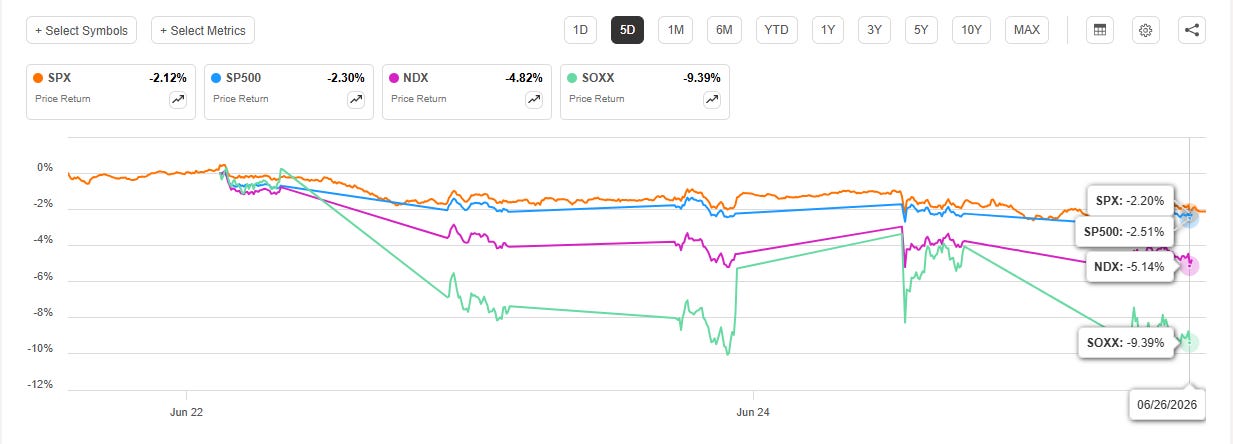
Markets are waking up to the reality that the biggest stocks in the market, which are also the biggest spenders on AI, have a difficult choice to make. They can continue spending and watch their stock prices wane, which is a problem when stock prices are the greatest incentive for management at these companies, or they can revise capex lower and risk a major vol event that sends the AI trade lower. The goldilocks outcome is that 2Q earnings again show immense returns on investment. Of the hyperscalers, I think Microsoft is the most likely to hint at reducing capex relative to expectations, given that it has been the most negatively affected.
Underneath the hood of a pressured index is an endless rotation into what were once ignored sectors. It almost feels like there is a new rotation every day. This has led to one of the most aggressive quarter-end rebalances I have ever seen.
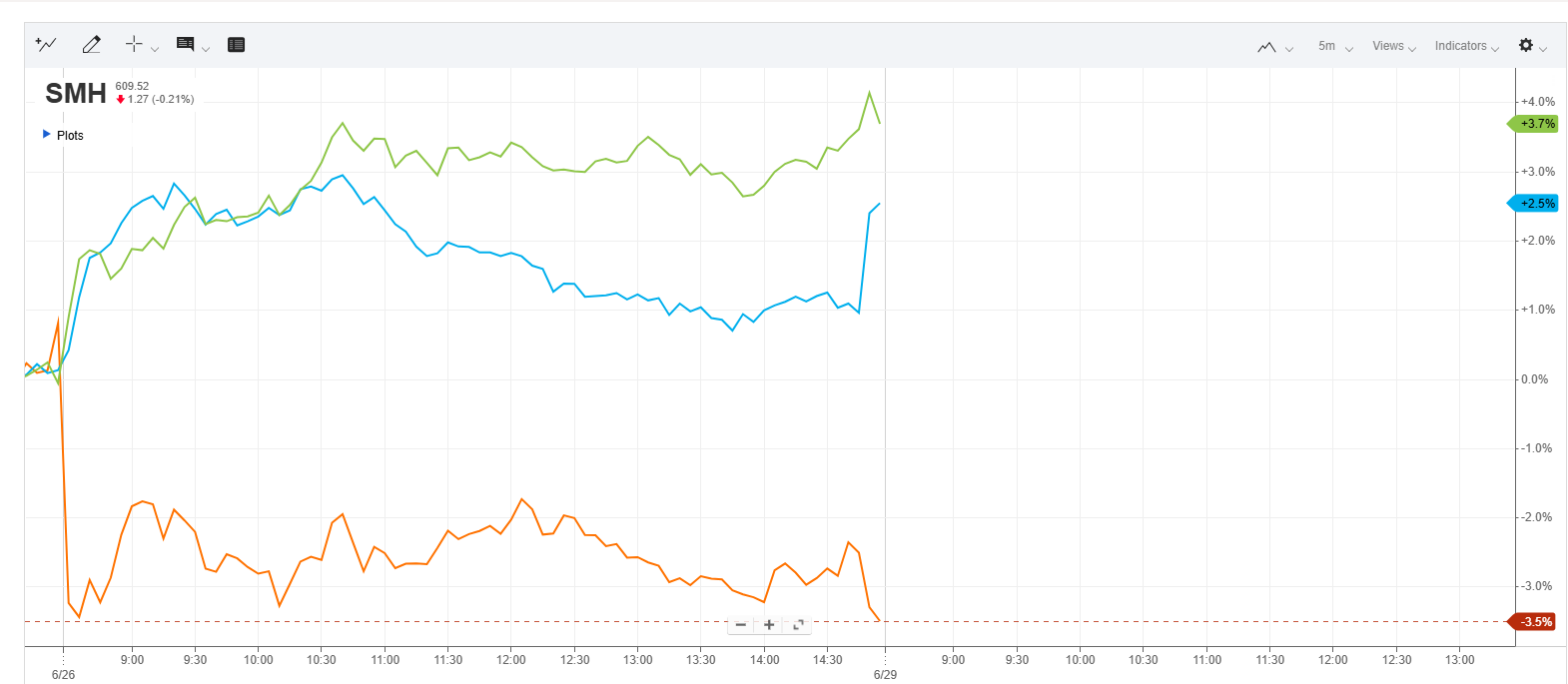
Does this mean the semis trade is over? No. A large chunk of the selling is likely tied to pension funds rebalancing back toward 60-40 portfolios after a historic run in semis that was due for profit-taking. But that does not change the fact that hyperscalers have to make a choice. I actually think semis and hyperscalers may be due for a bounce within the next few weeks, as stocks sold during quarter-end rebalances often recover in the early weeks of the new month.
Next week also happens to be one of the strongest seasonal weeks for stocks, matching the patriotism around the Fourth of July. I still think we are in the final innings of the AI trade as a whole. There will be pockets of outperformance, but it makes sense to diversify away, at least for the summer.
This is one of the main themes in the market today. While semi-only investors continue hunting for bottlenecks in what is likely the late stage of the AI trade, another theme is starting to come out of the shadows.
Another overhang on equities is the path of rates under a new Fed chair. On 06/17/26, the S&P dropped 1.2% after erasing intraday gains and catching many investors off guard. The Treasury market saw a sharp bear flattener as 2Y yields posted the largest single-day jump on an FOMC day since March 2008.
Since then, the yield curve has retraced all of the move and then some after positive developments around oil’s role in inflation.
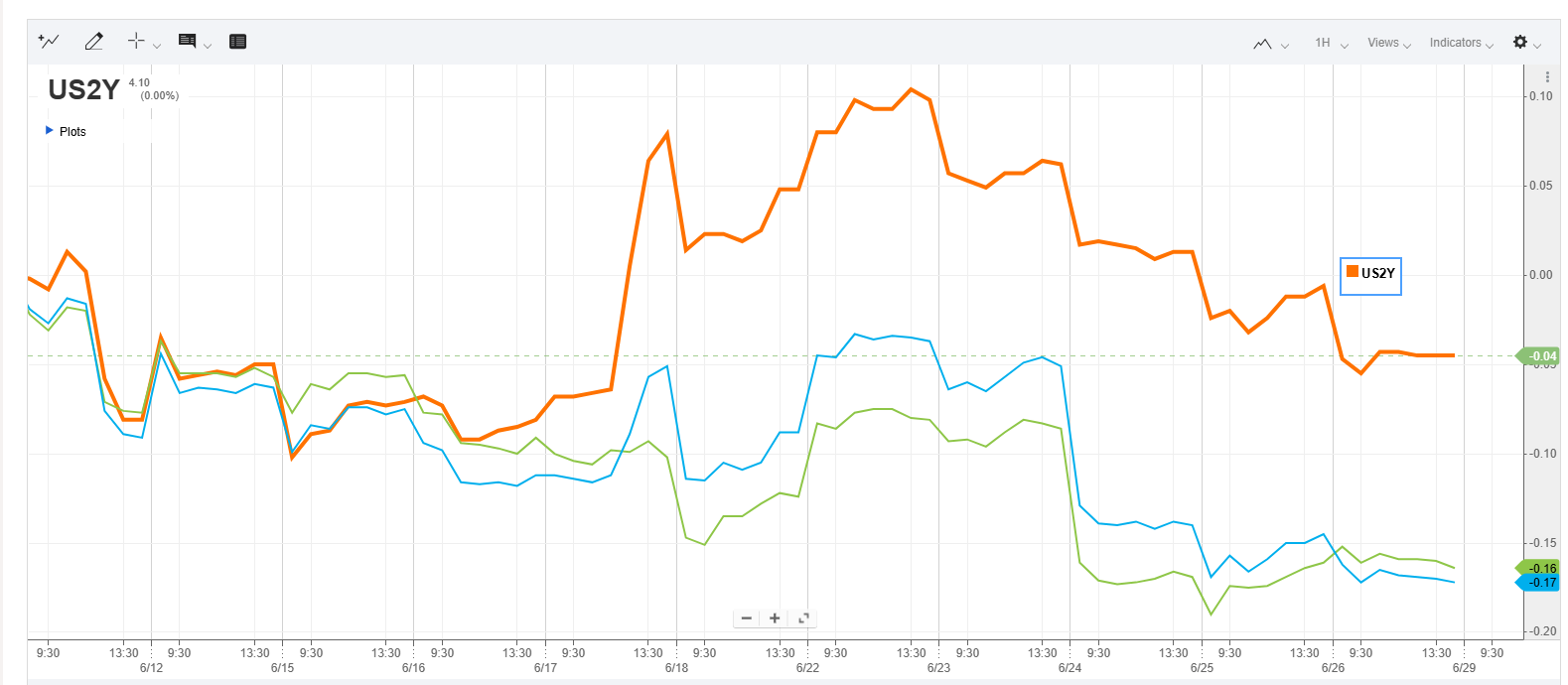
What shapes my view that rates are more likely to be held or cut than hiked is as follows.
Oil-driven inflation shock is fading
In the May CPI report, all-items inflation rose 0.5% month over month, while gasoline rose 7.0% and the broader energy index rose 3.9%. With gasoline carrying a 3.937% relative importance and energy carrying 7.474%, the direct contribution from gasoline alone was ~0.28 percentage points, while energy overall contributed ~0.29 percentage points.
PCE prices rose 0.4% in May and core PCE rose 0.3%, but the PCE energy goods-and-services price index jumped 4.0% in the month. Because energy spending represented a little more than 4% of total nominal PCE in May, the direct effect of energy was material. Real energy PCE actually fell 0.7% in May even as nominal energy spending climbed, which means the move was mainly higher prices and not booming real demand.
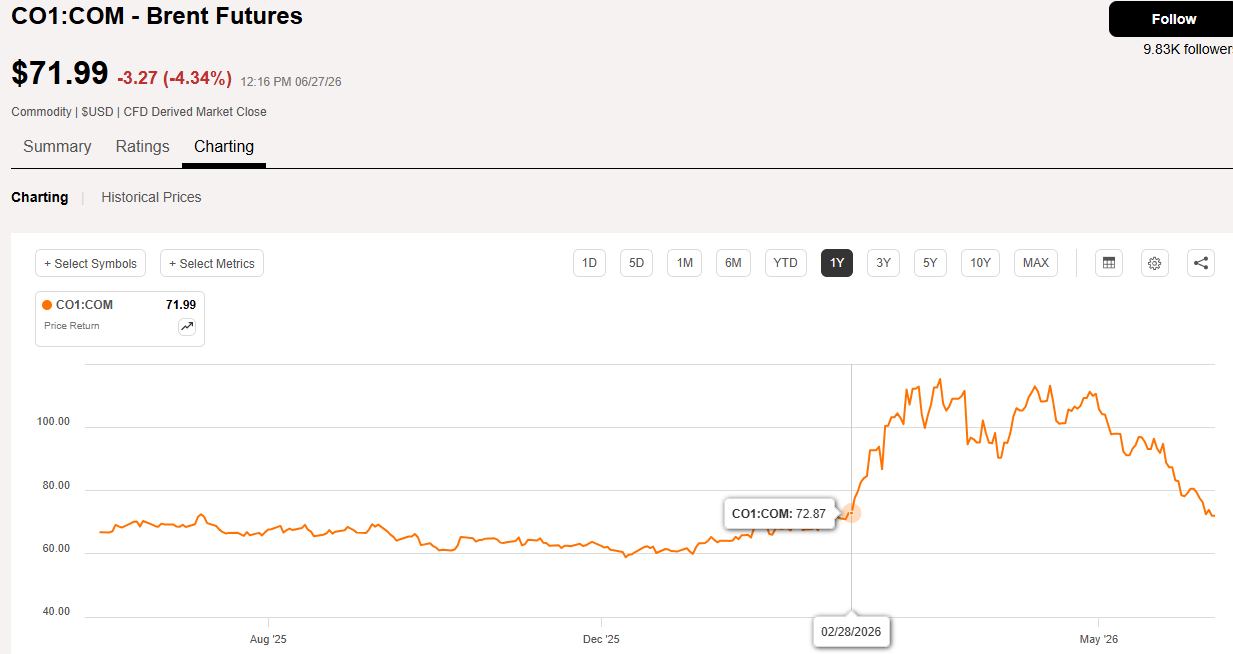
Following the interim peace framework, oil prices have returned to pre-conflict levels. We should see negative month-on-month inflation prints soon. Peak inflation for 2026 has likely already passed.
I think we are entering the disinflationary growth regime we saw at the start of the year.
Market’s inflation expectations vs. Fed hawkishness
The June FOMC median projects the fed funds rate at 3.8% by year-end 2026, 3.6% in 2027, and 3.4% in 2028, versus the current target range of 3.50%–3.75%. This is a meaningfully hawkish official policy path relative to where the market’s inflation expectations are trading. The Fed has turned hawkish for 2026 and expects a hawkish hold in 2027 before resuming cuts in 2028 and the longer run.
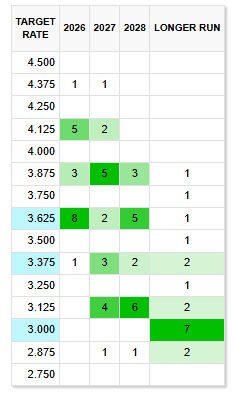
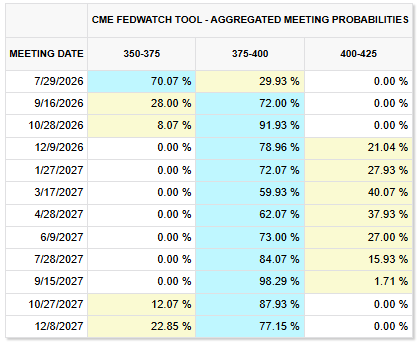
On the back of this, the market also prices one hike in 2026 and a hawkish hold in 2027.
As of June 26, the 10-year breakeven inflation rate was 2.20% and the 5y5y forward inflation expectation rate was 2.19%; even the 30-year monthly breakeven was only 2.30% in May. Put differently, the bond market is not pricing a de-anchoring of long-run inflation expectations. It is pricing inflation risk that is far closer to the Fed’s target than to the inflation prints that followed the oil spike.
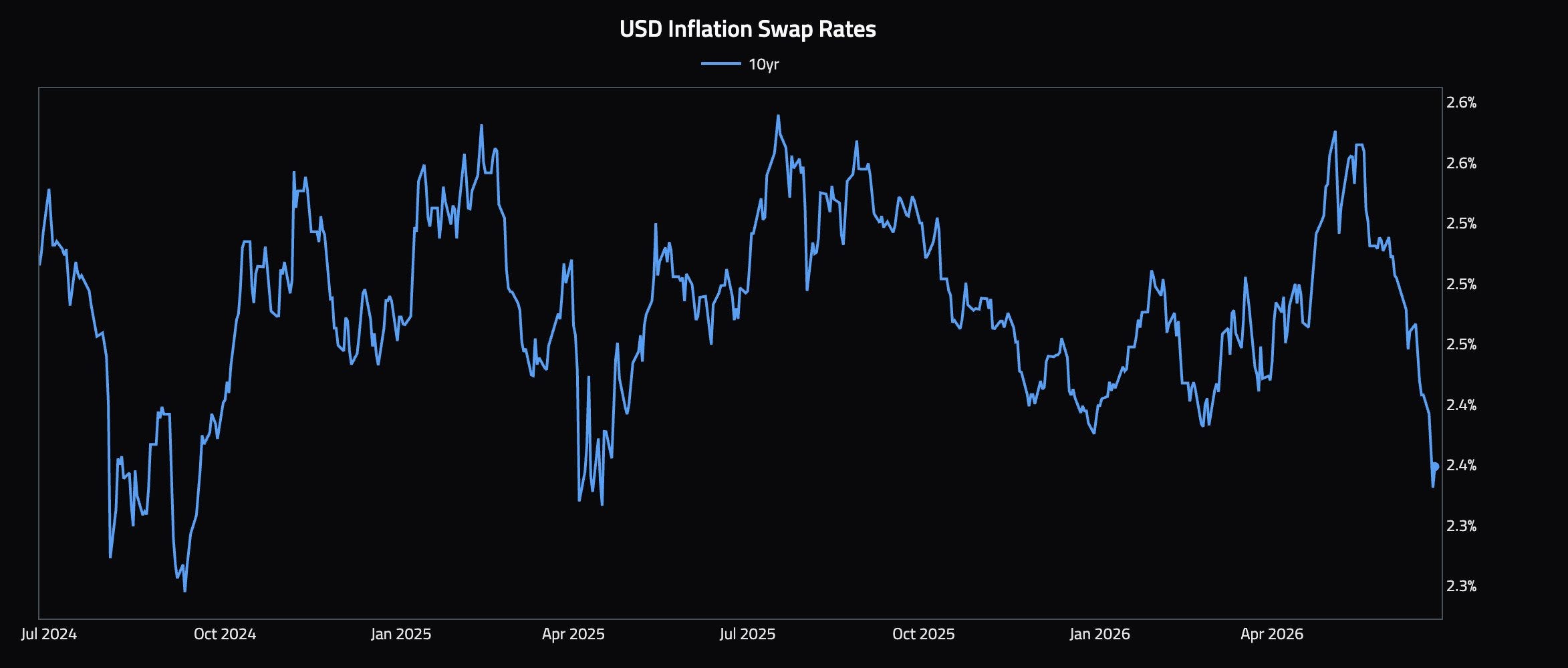
The drop in 10-year swaps shows institutional bond investors have high conviction in a return to price stability. This collapse in long-term inflation pricing has effectively offset the rise in real short-term rates, anchoring the long end of the nominal Treasury curve. The market is effectively telling the Federal Reserve that further rate hikes are unnecessary because the underlying inflation impulse has already faded.
In my view, the Fed is afraid to call any kind of inflation “transitory” because of the mistake made in 2021/2022. The difference today is that supply already exists for the commodity responsible for the inflation shock, which in this case is oil.
Kevin Warsh may not be as hawkish as the market assumes
The press has characterized newly confirmed Fed Chair Kevin Warsh as an unyielding hawk whose primary objective is to aggressively raise interest rates. This interpretation relies heavily on his past academic writings and his initial press conference on June 17, 2026, where he said the Fed’s commitment to price stability was “unambiguous and unanimous,” adding that “we have missed on inflation for five years and we are going to fix that.”
Warsh’s primary objective appears to be shifting the Fed toward a minimalist, market-driven framework. He is a long-standing critic of forward guidance, the practice of using explicit verbal commitments to steer future rate expectations. He believes this distorts market signals and forces private participants to trade on Fed commentary rather than organic economic data.
At his debut press conference, Warsh moved quickly to shrink the Fed’s communication footprint. The policy statement was cut to 130 words, removing language that markets could interpret as forward guidance. He also declined to submit an individual dot, saying his colleagues filled out their projections “with pencils... that have big erasers” given the rapidly changing global backdrop.
Warsh also launched five task forces covering Fed communications, the balance sheet, data reliance, productivity and jobs, and the inflation framework. The communications review will assess the SEP, dot plot, and public commentary, while the balance sheet review will revisit the ample reserves regime. The other reviews will focus on real-time/private-sector data, AI’s impact on labor markets, and alternative inflation measures such as trimmed mean inflation.
The inflation and balance sheet reviews are the most important for rates. Trimmed mean inflation gives Warsh a basis to avoid overreacting to energy-driven price spikes, especially with Dallas Fed Trimmed Mean PCE holding near 2.4% during the oil conflict. On the balance sheet, a shift away from ample reserves and toward scarcer reserves would let the Fed tighten liquidity by shrinking asset holdings rather than relying only on a higher fed funds rate. That creates a path for rate stability first, followed by eventual normalization.
So, the central goal of new chair Warsh is to reduce the Fed’s role in pricing the forward curve. My initial view is that this is a strong strategy. The downside is that rates, and by extension equities, will become more sensitive to monthly CPI, PCE, and employment prints. If you thought equities were volatile, rates are about to join that party.
In my view, the July meeting is the only real window for a rate hike this year, as I do not think the Fed will hike into the midterms. With inflation trending lower as the oil shock passes, a hike looks highly unlikely.
For Q3, which is what my screen is focused on, I think the market rotates into rate-sensitive equities. I also think Q3 could look like a toned-down version of the start of the year. Go long what worked in January, metals, EMs (outside the semiconductor-heavy markets like Korea and Taiwan), cyclicals, industrials, and so on.
What would render this screen worthless is a meaningful shift in the rate path caused by a return of the oil shock and/or surprise services inflation. A potential entry point could come from a strong jobs report next week, where seasonal hiring strength pushes yields higher and the market incorrectly interprets it as a sign of hikes, similar to the jobs report that caused carnage only a few weeks ago.
Let’s dive into my ideas. Note that this is not financial advice and is meant for research and entertainment purposes only.
Brazil
I have been bullish on Brazil since the start of the year, at least until the USD began strengthening. See my initial Brazil screen and select equities below. My top single-stock idea in Brazil is B3 SA Brasil Bolsa Balcao, the country’s major stock exchange, which I wrote about briefly in the screen below. I also like going long EWZ for broad exposure. With oil having found a bottom, in my view, downside in Petrobras looks more limited, while Vale gives EWZ direct materials exposure. Both are large holdings in the ETF.

Brazil is a major exporter, so it benefits from a weaker dollar, stronger commodity pricing, and improved EM flows. If U.S. hikes are priced out → USD down → EM currencies up → EWZ works.
Brazil is also on a path to easing one of the world’s highest policy rates. The Selic was recently cut to 14.25% despite an inflation print that came in above estimates. This suggests Brazil’s central bank is willing to look through the current oil-driven inflation shock as temporary.
Another dynamic in Brazil is fiscal stimulus in an election year. In my Brazil screen, I briefly discussed why Lula being re-elected is an over-feared scenario given his track record. That overhang is priced in, in my view. What is not priced is the potential upside if the conservative party wins and the market begins considering a more business-friendly policy path.
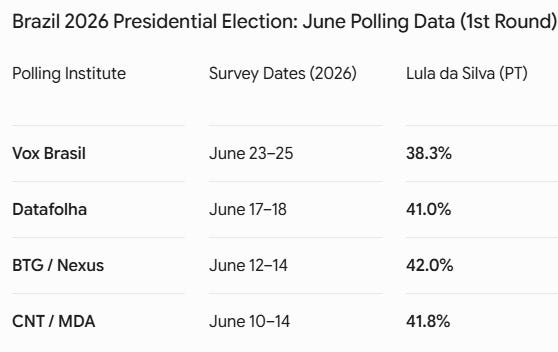
Apart from B3, Brazilian fintech should generally benefit from easier monetary policy and resilient consumption. Names like PAGS, STNE, XP, and NU are all trading at attractive valuations relative to their averages in what is likely to be an accelerating growth regime.
Metals: Gold, Silver, Copper
I have been burned on gold multiple times this year and have a better track record in copper. Even so, among the metals, I would rank gold and silver as better longs than copper for this specific setup.
I am a long-term copper bull, but given its correlation to the AI trade and the likely volatility ahead for AI-linked equities, gold and silver look like better near-term expressions of the rates-down, dollar-down trade.
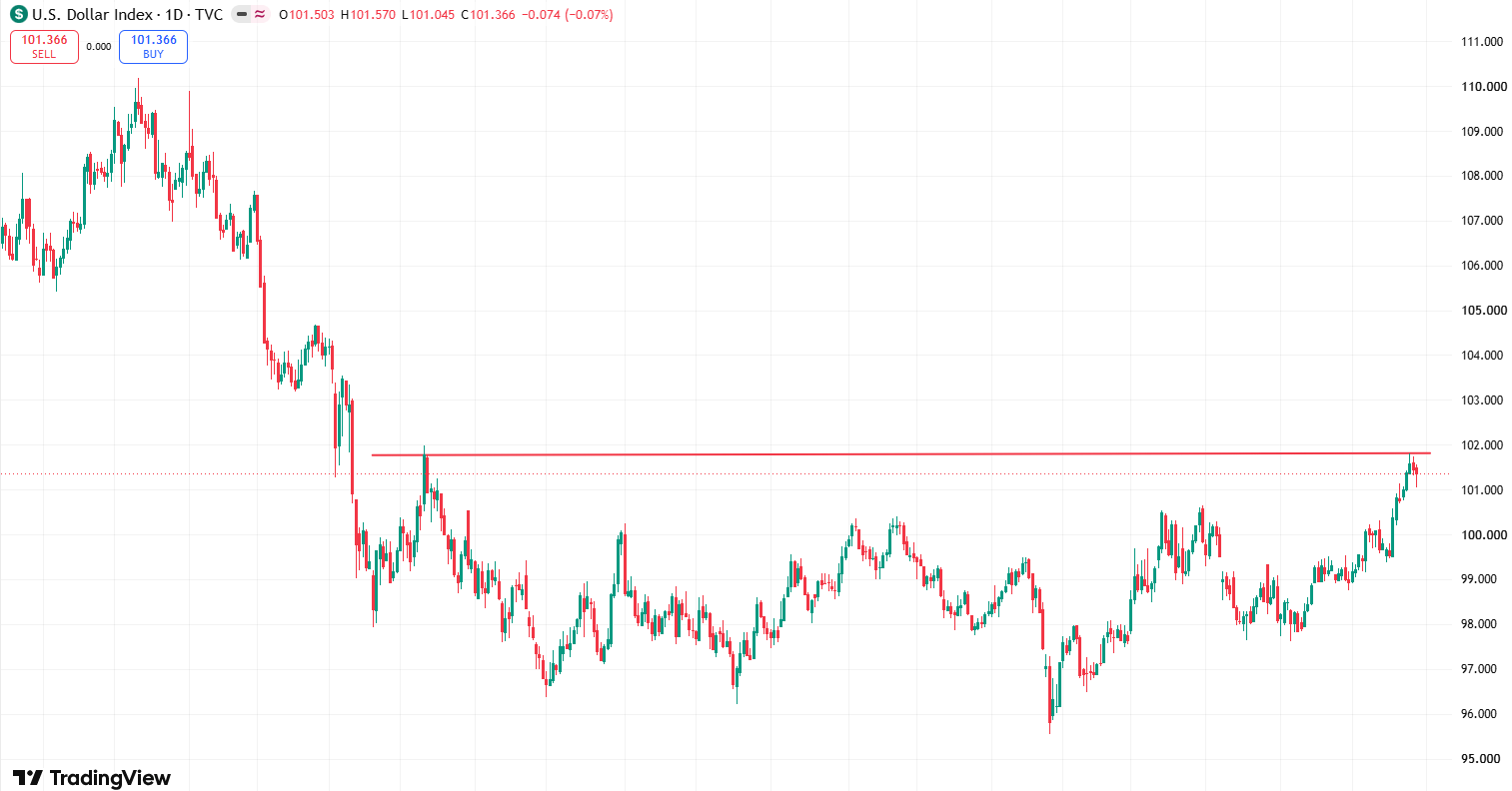
Metals should benefit from a weaker dollar. The main reason the USD broke out to new highs this year was the perceived hawkish pivot from the Fed, ongoing inflation pressure, and seasonally strong jobs reports. The hawkish impulse has outweighed geopolitical de-escalation. At the same time, the Eurozone has faced widening growth differentials versus the U.S. and worse terms of trade, while the BOJ’s move to lift its policy rate to 1.00% in June has not been enough to offset the massive U.S.-Japan rate differential, leaving the yen pinned near multi-decade lows.
I do not think DXY breaks above 102 in the near term. The FX market is already responding to the repricing lower in yields and the divergence between Fed officials and market-based inflation expectations.
My metals ideas are focused on both the commodities and the miners. Gold is bouncing near a key $4,000 level with record-high put skew, while silver has been left for dead. I do not expect a January-style squeeze in either, but I do think a recovery back to flat YTD is plausible under a rates-down and dollar-down scenario.
Lower oil prices also help miners through lower AISC. I particularly like miners with exposure across multiple metals. I have previously been long Ero Copper Corp for its copper and gold exposure, along with its operations in Brazil, which is also an oil-producing country. I have also liked KGHM, the leading silver and copper producer in Europe. Within gold miners, I like Kinross Gold Corp for its capital returns and long-term project pipeline, both of which can support multiple expansion.
U.S. Fintech
Amid this oil-driven inflation spike, consumer spending has stayed resilient. A good way to play this resilience is through consumer-facing fintechs, since they benefit from higher nominal spend while transaction volumes hold up.
In this realm, KLAR, Klarna, is my top idea and a position I am holding for the long term. Since my latest update, management has made progress on the metric that matters most: transaction margin dollars. The company is well on its way to becoming a full-fledged neobank, and U.S. consumer penetration should continue increasing with the already successful Klarna card and new features like high-yield savings accounts.
A new catalyst has also emerged through Klarna’s subsidiary PriceRunner and its massive antitrust damages lawsuit against Google. PriceRunner is seeking 77B SEK, or ~$8B, on claims that Google broke EU competition laws.

I do not believe BNPL is a winner-take-all market, and given TAM growth, I also like AFRM, Affirm, as a Q3 idea.
Shift4, FOUR, is another strong pick worth investigating. While I personally have issues with how they present organic growth given their M&A strategy, the stock has been unfairly hit during the fintech selloff. Shift4 is also a direct beneficiary of the 2026 World Cup through payment processing at many stadiums, while also benefiting from foreign-issued card spending through its Global Blue acquisition. The stock trades at a large discount to the sector and its five-year average.
RKT, Rocket Companies, is more of a mortgage-rate and housing-duration trade than a broad fintech trade. With home affordability coming back into focus and hikes being priced out, RKT is a bet on a recovery in mortgage loan origination volume. With the Redfin deal, RKT is now one of the most integrated housing platforms. The Compass partnership adds another demand channel, with Compass inventory expected to appear on Redfin and the potential for more than 500,000 additional listings to flow onto the platform.
A retail favorite that could work is SOFI. If rates move lower while consumption stays resilient, SOFI should benefit directly through loan originations, funding costs, and stronger demand across its financial services platform. The obvious negative is relentless shareholder dilution, but for a quarter-long trade, shares look attractive here with an average sell-side target of ~$20/sh.
Luxury Marketplaces
Luxury marketplace stocks should be one of the better expressions of a rates-down/spending-up trade. Non-store retailer spending surged 12.2% in May, and there are not many pure plays listed in the U.S. Both names below are also undergoing a margin inflection.
REAL, The RealReal, is a direct luxury resale marketplace. 1Q26 marked its fourth consecutive quarter of double-digit top-line growth. The company is adding new high-volume markets in San Francisco and Boston in 2026 and raised GMV guidance on the back of higher AOV. Higher AOV is helping margins, while AI is improving pricing and marketing efficiency. Average sell-side target is ~$17/sh.
DIBS, 1stDibs.com, is the more rate-sensitive and high-beta version. 1stDibs is a marketplace for luxury design, furniture, art, jewelry, and vintage fashion. It should benefit if lower rates revive high-ticket discretionary spending, housing turnover, interior design demand, and wealth-effect purchases. Recent top-line weakness has forced the company to execute on adjusted EBITDA. A recovery in housing should help management achieve its goal of returning to GMV growth by 4Q26.
Value-focused Consumer Discretionary
This is a play on resilient low-income consumption. My top pick here is JAKK, JAKKS Pacific, a toy company set to inflect on the return of FOB ordering and a materially better content slate in 2027. Other picks are mentioned in the screen linked below. Aside from JAKK, DECK looks attractive heading into earnings at the end of the month. The company continues to take share from Nike in footwear.

