
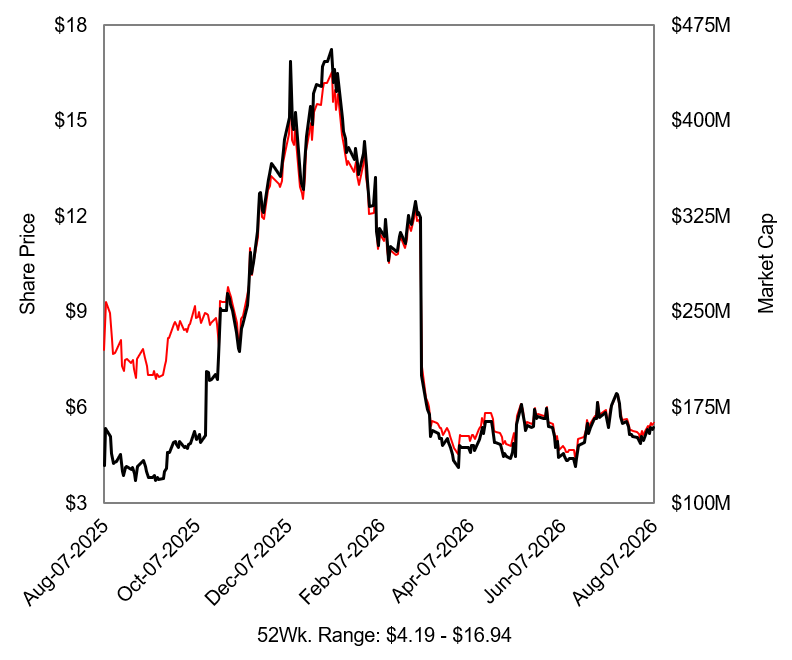
Quick Pitch | $OWLT - Owlet, Inc.
A category leader with 100%+ upside

Down 66% YTD, the remaining bulls have completely fled OWLT. The euphoric 8-month rally from April through December 2025, during which the stock rose ~472%, came to an abrupt end in early 2026. The downdraft has only worsened following weak guidance in the 4Q25 and 1Q26 prints.
With the company reporting 2Q26 earnings this Tuesday (08/11), I wanted to take a shot at bottom fishing and see whether there is enough upside to justify the risk. I have come to the conclusion that the risk/reward is attractive for a non-core position in a market-share-leading, single-category company. If the thesis works, I think the stock could double relatively quickly. If it does not, I see downside of 20%–30%.
OWLT is by no means a “fantastic business,” but it piques my interest because I have a variant view on how the business could perform over the next two years. This pitch will be relatively short because I do not have high conviction yet. I plan to use Tuesday’s print to decide whether to hold, add and make it a core position, or cut it entirely. If I decide to add, I will supplement this mainly qualitative quick pitch with a deeper thesis and a model.
Disclaimer: Nothing posted by P14 Capital should be considered financial advice. The author of this post holds a long position in the stock discussed. Please consult a financial advisor and/or conduct your own due diligence before making investment decisions.
Owlet, Inc.
NYSE: OWLT | 08/07/2026
Business Overview
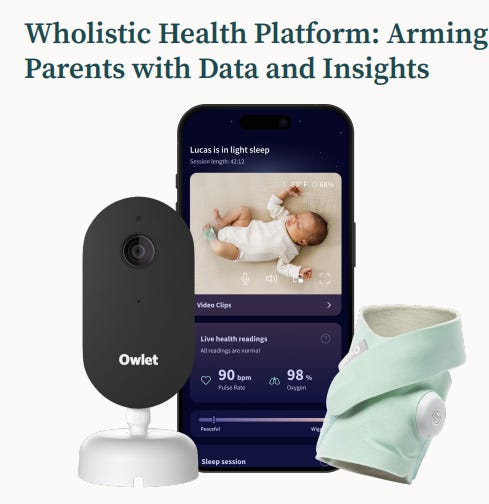
Owlet was founded in 2012 and incorporated in 2014, initially developing the Smart Sock before commercial sales began in 2015. The company added Owlet Cam in 2018, Dream Sock in January 2022, FDA-cleared BabySat and Dream Sock with Health Notifications in 2024, and Owlet360 and Dream Sight in 2025. Today, Dream Sock is a $299.99 OTC infant wearable that monitors pulse rate, oxygen, activity and sleep; Dream Sight Gen 3 is a $99.99 video monitor; Dream Duo Gen 3 bundles the two for $379.99; and BabySat is a $699 prescription pulse oximeter for physician-supervised home monitoring. Owlet360 adds personalized health and sleep analytics for $9.99/month, while Owlet One bundles Dream Sock, Dream Sight and Owlet360 for $99 upfront plus $19/month with a 6-month minimum. More than 2.5M families have used Owlet across 30+ countries, and well over 500K parents purchase a new device each year. Owlet went public through a July 2021 SPAC combination with Sandbridge Acquisition Corp. at $10/share, or $140/share adjusted for the 2023 reverse split. The company is now building a broader pediatric health platform around monitoring, software, data and AI.
Revenue increased from $54.0M in FY23 to $78.1M in FY24, +44.5% Y/Y, $105.7M in FY25, +35.4%, and $107.1M LTM through 1Q26, +26.8% Y/Y. On an LTM basis, the U.S. generated $87.0M, 81.3% of revenue and +29.2% Y/Y, the U.K. $6.5M, 6.0% and +16.8%, and other international markets $13.6M, 12.7% and +17.9%. In 1Q26, hardware generated $19.8M, 88.1% of revenue and -4.5% Y/Y, compared with $2.7M from Owlet360, 11.9% of revenue and +569.3%, with subscription gross margin of 67.4% versus 52.8% for hardware. Gross margin increased from 41.8% in FY23 to 50.4% in FY24 and 50.6% in FY25, with LTM gross margin at 50.9%, down 137 bps Y/Y. Adjusted EBITDA improved from $(16.3)M in FY23 to $(1.8)M in FY24, $2.0M in FY25 and $0.4M LTM, equal to a 0.4% margin. Results are seasonal, with Q4 typically the strongest sell-in period from holiday promotions and Amazon 1P volume, followed by a Q1 step-down and stronger Q2 demand around Mother’s Day.
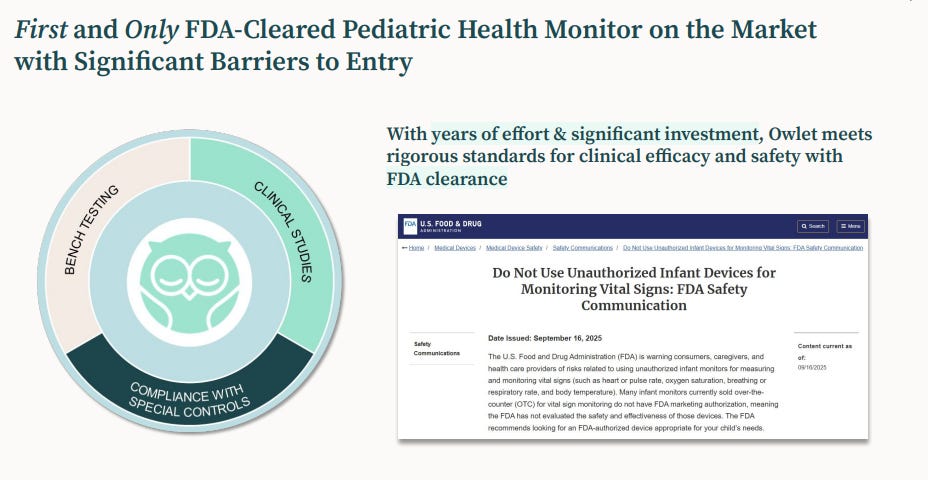
Owlet is the U.S. baby-monitor market-share leader, with 41% of category dollar spend in 4Q25. Its competitive advantages come from scale, FDA clearance, its pediatric dataset, brand and the integration of wearable monitoring, video and software. The regulatory path took years of product iteration across multiple generations of sock hardware, and the October 2021 FDA warning forced Owlet to stop U.S. Smart Sock sales before securing BabySat clearance in June 2023 and first-of-its-kind Dream Sock De Novo authorization in November 2023. Dream Sock’s application was supported by 9 formal clinical evaluations and data from more than 300K infants, and Owlet’s broader dataset now includes more than 17T heartbeats. Masimo, a well-capitalized competitor, received OTC FDA clearance for its Stork monitor in May 2024 but exited the product within a year, showing that clearance alone does not guarantee commercial success.
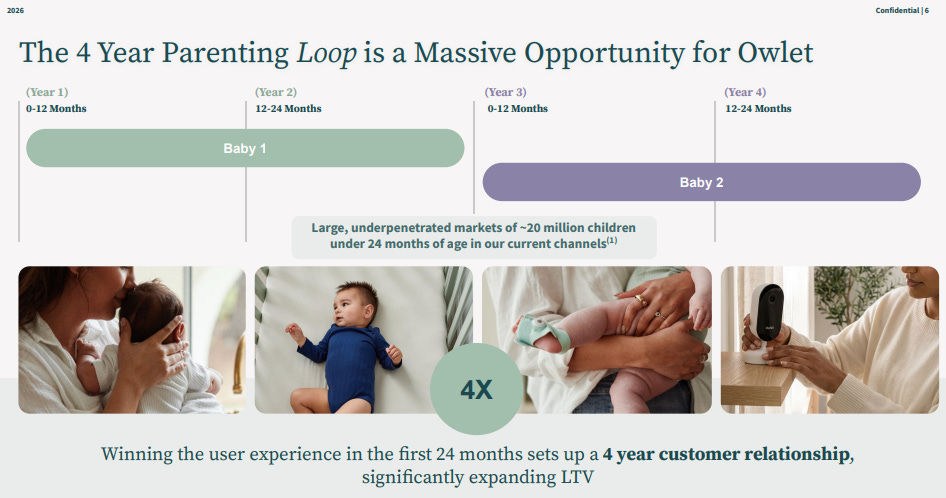
The broader smart baby-monitor market is projected to grow from $1.7B in 2024 to $3.2B by 2032 at an ~8% CAGR, and Owlet targets markets representing 33M+ annual births. Management is focused on increasing LTV through a 4-year family relationship built around subscriptions across the first two years of each child and the typical two-child family cycle.
Co-founder Kurt Workman returned as CEO in April 2026 after Jonathan Harris resigned without a stated reason. Amanda Crawford, CFO, has been with the firm since 2022. As of 1Q26, Owlet had $35.5M of cash, $6.3M of WTI principal and $13.4M drawn on its old ABL. In June, the company replaced both facilities with a $25M Wells Fargo revolver, expandable to $35M, priced at SOFR +2.00% to 2.25% versus SOFR +7.50% to 8.50% previously and maturing in June 2029; liquidity was $33.8M at closing. Workman’s current package includes a $500K base salary, 70% target cash bonus and 850K RSUs. The annual bonus program has been tied to EBITDA, and performance RSUs granted to other executives are tied to cumulative net revenue through 2028, aligning compensation with profitability and revenue growth.
The Quick Thesis
The primary reason for the YTD flush has been the sharp deceleration in top-line growth, made worse by management’s ugly FY26 guidance reset.
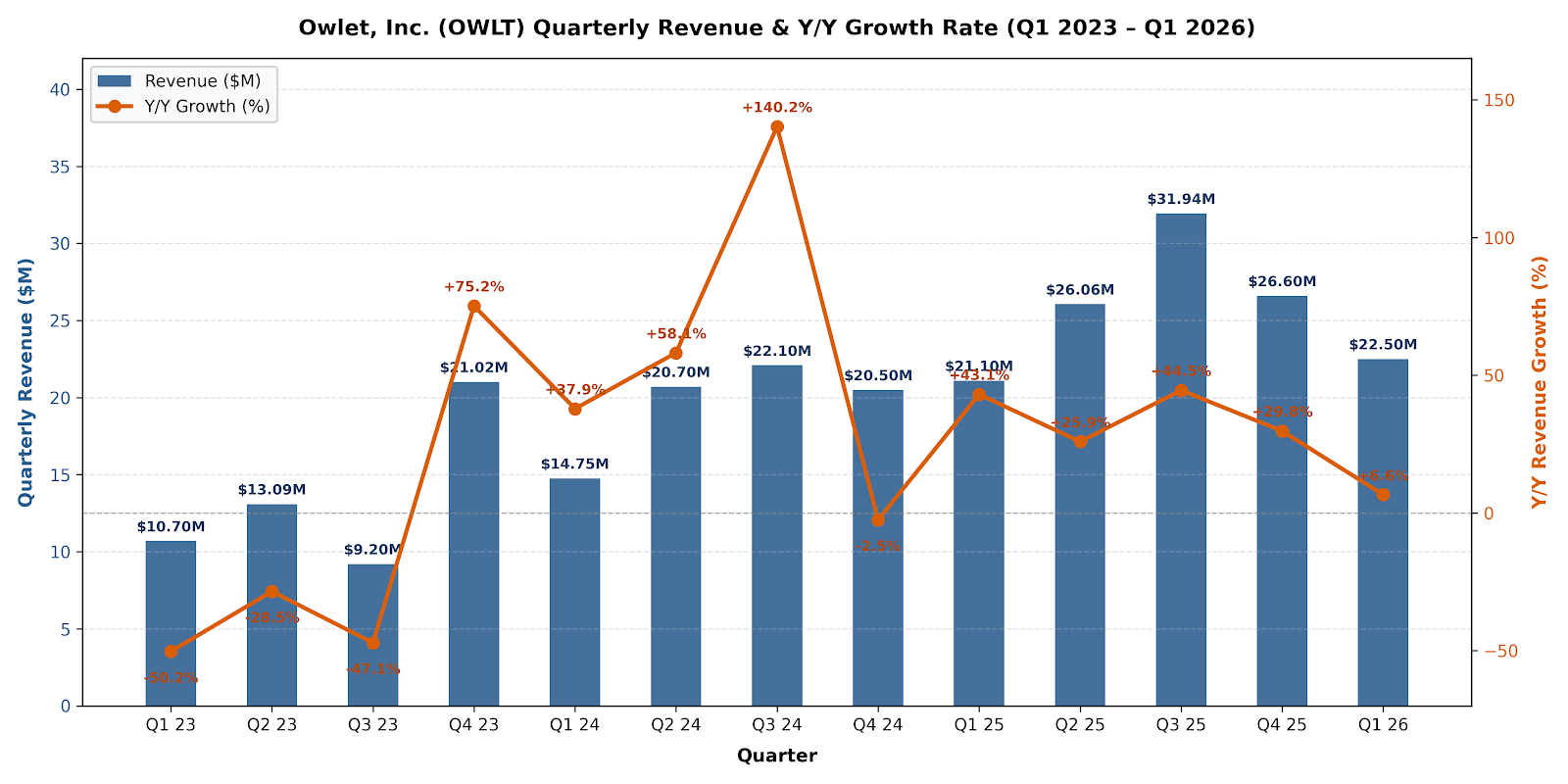
Owlet beat 4Q25 consensus estimates but initially guided to a weak 1Q26, which is normal given the seasonality of the business. More damaging was the initial FY26 outlook for $126M-$130M of revenue, or 21.1% Y/Y growth at the midpoint, a sharp slowdown from FY25’s 35.4% growth. Management also guided to $3M-$5M of adjusted EBITDA, implying ~120bps of margin expansion at the midpoint. The 1Q26 update then cut FY26 revenue guidance to $118M-$122M, or 13.5% growth at the midpoint. At the same time, management doubled the adjusted EBITDA midpoint from $4M to $8M, taking implied FY26 adjusted EBITDA margin expansion to ~475bps.
For a formerly fast-growing company still GAAP unprofitable, resetting expected revenue growth from 21% to 13.5% is an obvious negative on first glance. The market reacted accordingly, or at least most participants think it did. OWLT’s EV/Sales multiple has been crushed from 4.6x TTM at the close of 12/31/2025 to just 1.4x today. I think Mr. Market has focused almost entirely on the top-line reset and given little credit to what is happening underneath it.
This multiple reset is where I think the long opportunity lies heading into the print.
Let us address the short-term catalysts that show up in 2Q26, the first near-term test. Q1 is consistently Owlet’s weakest quarter following the holiday period, with lower promotional activity and a seasonal sell-in step-down. Management expects revenue to recover in Q2, followed by a slight sequential decline in Q3 and an annual high in Q4. Historically, Q2 earnings have also tended to produce positive returns on the stock.
The FY26 revenue cut is not driven by a deterioration in end demand. A major retail partner reduced inventory requirements from 8-10 weeks of supply to 4-6 weeks. This has created a broader ~$7M inventory headwind, which has already passed. Management described the Q1 rightsizing as a one-time event, so this portion of the reset has already occurred. The revised outlook also embeds a more conservative sell-through assumption for the rest of the year, along with the decision to defer lower-return markets including India, Hong Kong and Singapore and pull spending tied to lower-margin, high-burden channels. No quantitative 2Q26 guidance was provided.
Consensus expects 2Q26 revenue of $31.9M, up ~22% Y/Y versus 26% growth in 2Q25. I think both revenue and margins can beat.
Reported 1Q26 hardware revenue was hurt by the retailer inventory reset, yet U.S. Dream Sock and Duo sell-through still grew 10.5% Y/Y. Duo units increased 45% and Dream Sock increased 3%. Owlet was also the only brand growing in a weak category. Excluding Owlet, baby-monitor category dollars fell 19% Y/Y in Q1, compared with an 11% increase for Owlet.
More importantly, in the 1Q26 call, management already gave us a read on 2Q demand one month into the quarter. After optimizing marketing and retail placement entering Q2, QTD sell-through had accelerated to more than 30% Y/Y for both Dream Sock and Dream Duo. Management specifically said this strength was not incorporated into the revised FY26 outlook because it wanted more sell-through data first. Registry additions also entered Q2 strong, with Dream Sock +31% Y/Y and Duo +44% in Q1.
Management then leaned heavily into promotions throughout the rest of the quarter instead of waiting for Prime Day. The Mother’s Day campaign ran May 3-17 across Amazon, Walmart, Target, Best Buy, Babylist and Owlet.com, with $60 off Dream Sock, $80 off Dream Duo 3 and $20 off Dream Sight. Owlet also partnered with Dani Austin’s Divi brand, offering a free $48 Divi serum with Dream Sock or Duo purchases on its own site, followed by a $349.99 Duo 3 + Divi bundle. Memorial Day followed from May 22-25, with a free $99 Dream Sight included with a Dream Sock purchase. Owlet then ran 15% off Dream Sock, Duo and Dream Sight from June 1-13, another 15% sitewide Father’s Day promotion from June 19-21, and Prime Day from June 23-26. Virtually all of May and June had some form of consumer incentive.
Traffic has also been improving with Owletcare.com receiving 349K visits in May, up 36.2% M/M from 256K in April, followed by another increase to 416K visits in June. Additionally, commentary during the 06/02 TD Cowen conference suggested that April momentum has continued on to May.
Prime Day is another important 2Q26 catalyst. Interestingly, this was only the second time Prime Day landed in June, after 2021. Adobe measured $26.4B of U.S. online spending over the four-day event, up 9.3% Y/Y. Adobe also said electronics sales were +120% versus average June daily sales, while baby products saw major spikes, including strollers +195%, car seats +140%, and formula and diapers/wipes +75%. Discounts also drove purchases of higher-ticket discretionary products, including electronics, toys and children’s products. This is directly relevant to a $190-$270 promotional baby-monitor purchase.
Numerator found average Amazon order value declined to $47.66 from $53.34 and household Prime Day spending declined Y/Y. I think this makes Owlet’s promotional positioning more important. Nearly half of Prime Day shoppers said they had been waiting for an item to go on sale before purchasing it. A $299 Dream Sock is exactly the type of discretionary baby product parents can delay until a major promotional event.
Owlet also received unusually strong placement during the event. Dream Duo appeared in Amazon’s own official Prime Day deal coverage at up to 33% off, while Forbes highlighted Dream Sock among the best nursery deals at 37% off.
The quarter also had incremental product support outside the U.S. In May, Owlet launched the full Dream ecosystem in Australia and New Zealand with Dream Sight and Dream Duo 3, building on the existing Dream Sock footprint. Owlet OnCall also went live inside the app for select participants during the quarter.
2Q26 consensus calls for a 50.65% gross margin and 7.77% adjusted EBITDA margin. At $31.9M of consensus revenue, this implies ~$16.2M of gross profit and ~$2.5M of adjusted EBITDA.
With this promotional activity, consensus already assumes meaningful gross-margin compression. The 50.65% estimate is 385bps below the 54.5% reported in 1Q26 and below the 51.3% reported in 2Q25.
Owlet360 generated $2.7M of revenue in 1Q26 at a 67.4% gross margin, well above the 54.5% consolidated gross margin. Paying subscribers surpassed 115K, MRR reached $1M, and U.S. Dream Sock subscription penetration reached 34%. Subscription revenue exceeded 10% of total revenue and increased sequentially again, giving Owlet a much larger high-margin recurring revenue base entering 2Q than it had a year ago.
Owlet generated a 54.5% gross margin in 1Q despite a 480bps tariff headwind. Management subsequently lowered its tariff assumption for the rest of 2026 to 15%, versus the prior 19% assumption for Thailand and 20% for Vietnam. Consensus should already capture some of this improvement, but tariff costs below the 15% baseline would create additional upside.
Management also attributed part of the 1Q gross-margin beat to a more favorable mix of Dream Sock versus cameras. Dream Sock was one of Owlet’s most heavily promoted products during Prime Day, so strong Sock volumes could help offset some of the lower promotional ASP. Duo has more camera exposure, but stronger Duo sales also expand the installed base available for Owlet360 conversion and increase LTV beyond the original hardware purchase.
Volume itself can help. Owlet generated a 51.3% gross margin in 2Q25 despite promotions and tariffs, helped by higher revenue, favorable product mix, lower direct product and fulfillment costs, and better fixed-cost absorption. If sell-through stayed anywhere close to the >30% Y/Y growth management disclosed in early May, higher hardware volume should provide another source of gross-margin support.
Management eliminated planned headcount additions, deferred lower-ROI projects outside the core 0 to 24-month market, paused new-country launches carrying regulatory, engineering, quality and marketing costs, and shifted spending toward higher-return projects. These changes could reduce the 2026 cost structure by ~$8M.
2Q is the first full quarter where some of these savings should begin flowing through. If revenue beats the $31.9M consensus estimate, the incremental earnings impact could be meaningful. At a 50.65% gross margin, every additional $1M of revenue produces ~$507K of gross profit before incremental operating costs. With planned hiring reduced and much of G&A and R&D already in place, a revenue beat should carry much stronger flow-through to adjusted EBITDA than the consolidated margin suggests.
Long-term thesis
I think we are likely to see a beat and raise on both revenue and adjusted EBITDA. If I like what I see in the 2Q print, I will expand on the following long-term drivers in a separate post.
The international opportunity
Insurance reimbursement
More on the subscription mix shift and why it will work
The telehealth opportunity
Increasing penetration in U.S. and international markets
The high probability of a buyout
Dilution and other key risks
And more…
Thanks for the write-up, but why should it double ?
They had $8,6Mio SBC in 2024 and $9,4Mio in 2025, D&A doesnt overstate capex, theres a bit of IntExp, NOLs are gonna keep the taxrate low for a while, but really your aEBITDA is just employee compensation and other real costs, so I dont see any value there with 13% Revenue growth, operating leverage cant be that extreme unless they cut OpEx.
Im seeing a couple funds entering in Q4 2025, eclipse has reduced their stake from 34% to 27% during that time so still bagholding a lot since IPO, does that play a role here ?