
$REAL - The RealReal, Inc.
70% Upside in a GARP Stock Undergoing an AI-Driven Margin Inflection

Disclaimer: Nothing posted by P14 Capital should be considered financial advice. The author of this post holds a long position in the stock discussed. Please consult a financial advisor and/or conduct your own due diligence before making investment decisions.
The RealReal, Inc.
NASDAQ: REAL | 07/24/2026
Thesis Summary
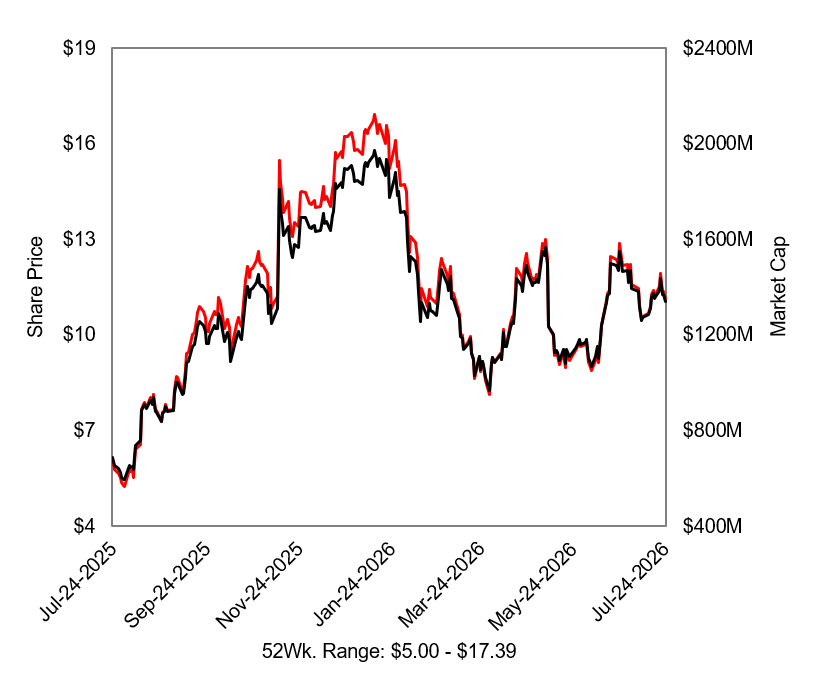
Up ~100% over the past year but down ~29% YTD, REAL looks like a turnaround losing momentum. Mr. Market has penalized the stock for guiding to flat Q/Q revenue and lower AEBITDA in 2Q26, while assuming difficult 2H26 comparisons will force growth to decelerate. At 24x NTM EBITDA, the market also views the stock as expensive relative to peers and prices the profitability inflection as largely complete.
I believe the market’s view is shortsighted. REAL is solidifying its leadership in authenticated luxury resale, supported by a growing market, strong repeat engagement, and a differentiated consignment model that deepens supply and buyer liquidity. The shift toward watches, jewelry, and other hard-luxury categories is expanding AOV, while B2B drop-ship, international sourcing, Smart Sales, My Closet, and Athena increase the volume and velocity of supply reaching the platform.
I forecast FY26 revenue growth of 13.3% and GMV growth of 15.0%. From FY26 to FY28, I project a 12.1% revenue CAGR and 13.5% GMV CAGR, above consensus estimates of 10.8% and 12.8%, respectively. Growth is driven by higher-value supply, buyer and order expansion, faster speed-to-site, and broader adoption of luxury resale. These drivers support a longer top-line runway than the market currently expects.
The larger upside comes from the margin profile. Athena reduces labor intensity across intake, authentication, pricing, and listing, while higher AOV increases GMV and profit dollars without a proportional increase in processing costs. I forecast AEBITDA margin expanding from 7.1% on an LTM basis to 13.5% in FY28, still below management’s 15%-20% medium-term target. Positive FCF, debt reduction, an extended maturity profile, and management incentives tied to unlevered FCF strengthen the path toward sustained profitability and deleveraging.
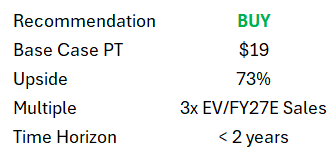
REAL trades at ~2.3x EV/TTM Sales and ~1.9x EV/FY27E Sales, below larger marketplace peers despite stronger growth and a credible margin inflection. Applying a 3.0x multiple to FY27E revenue of ~$879M produces a $19.22 base-case price target, representing 73% upside. My bear case implies a ~$7 share price and 37% downside, creating an attractive risk/reward for investors willing to underwrite the business beyond the next few quarters. Luxury resale is becoming a durable consumer channel, and REAL is positioned to capture a disproportionate share of its growth.
Business Overview
Founded in 2011 by Julie Wainwright, The RealReal (REAL) is the largest online marketplace for authenticated luxury resale. Its end-to-end model removes friction from selling high-value goods by managing sourcing, authentication, pricing, merchandising, customer service, returns, and fulfillment across fashion, jewelry, watches, art, and home decor. Since its 2019 IPO, REAL has shifted away from lower-value, high-volume inventory toward a consignment-led model focused on higher-value luxury goods and deeper technology integration. As of 1Q26, the platform serves more than 40M members and ~1.1M active buyers, primarily in the United States, supported by a selective retail footprint in New York, Los Angeles, Chicago, San Francisco, and other major markets. REAL’s broader mission is to extend the lifecycle of luxury goods and support a more circular fashion economy.
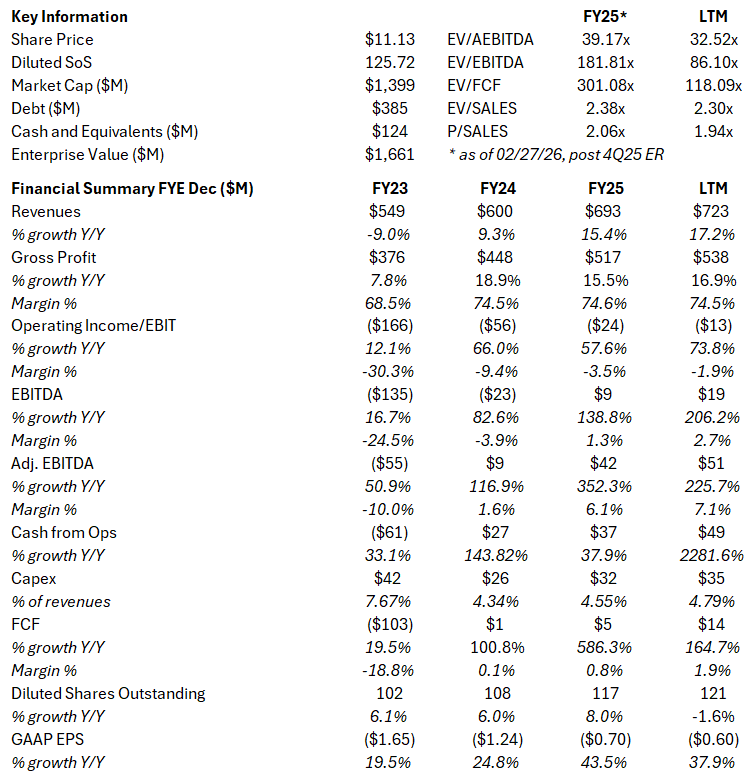
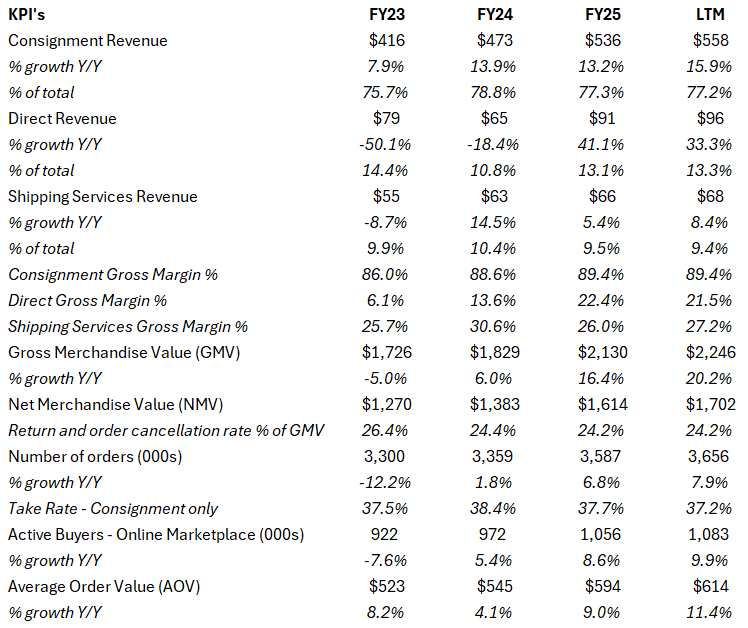
REAL generated $692.8M of revenue in FY25, up 15.4% Y/Y, with a consolidated gross margin of 74.6%. AEBITDA increased to $42.1M from $9.3M in FY24, with margin expanding 450 bps to 6.1%. FY25 was the first year in which REAL generated positive AEBITDA in every quarter. GMV increased 16.4% to $2.13B, while active buyers reached 1.06M at year-end.
Revenue is generated across three verticals. Consignment revenue increased 13.2% to $535.9M, representing 77.3% of FY25 revenue, with an 89.4% gross margin. Under this capital-light model, REAL sells goods on behalf of consignors and retains a percentage of the proceeds without taking legal title to the inventory. Direct revenue increased 41.1% to $91.1M, with a 22.4% gross margin, and consists of merchandise purchased and resold by REAL as principal. Shipping services revenue increased 5.4% to $65.9M, with a 26.0% gross margin, and primarily includes delivery, handling, and consigned-product return fees.
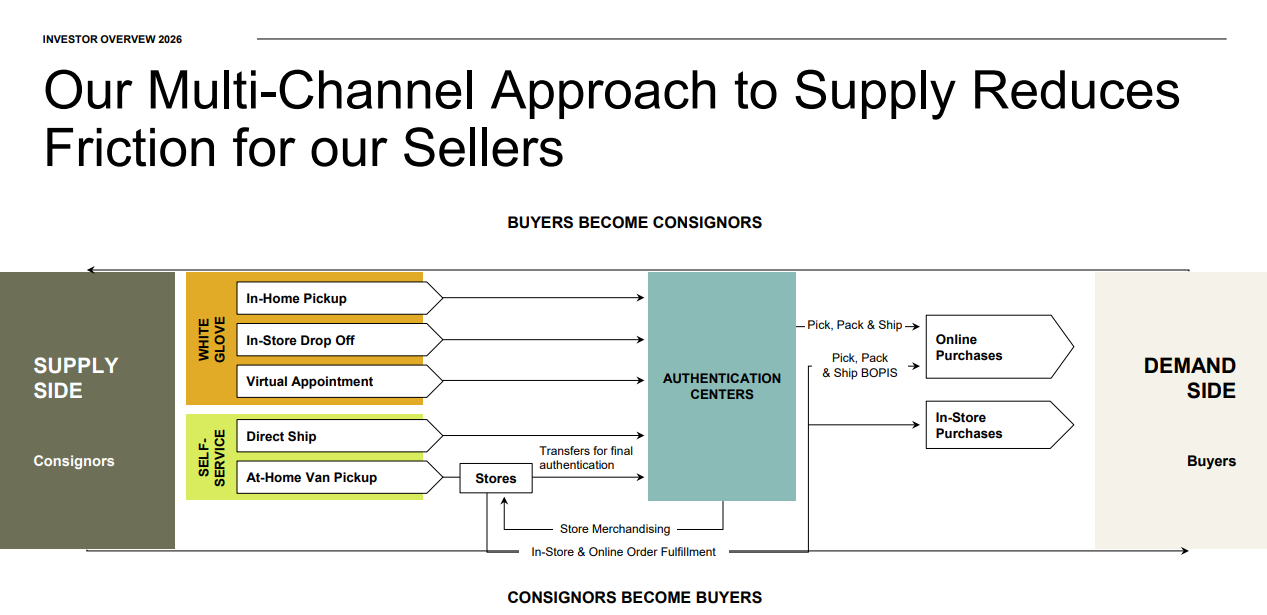
REAL operates an omnichannel marketplace, with its website and mobile app generating most transaction volume and its flagship and neighborhood stores supporting customer acquisition, brand trust, and supply growth. Active members spend more than 40 hours annually on the platform. Physical locations serve as convenient drop-off and valuation points, allow consignors to interact directly with luxury specialists, and generate ~25% of new consignors.
The company manages two inventory models based on title and control. Under consignment, REAL takes physical possession of an item and manages the sale, while legal ownership stays with the consignor until the item is sold and the return period expires. Under the direct model, REAL purchases and takes title to merchandise, primarily through its Get Paid Now program and out-of-policy customer returns.
REAL’s core differentiator is its fully managed, “A to Z” service. Items are collected through in-home appointments, store drop-offs, or direct shipment and transferred to authentication centers in Arizona or New Jersey. Specialists, including gemologists and horologists, authenticate and grade each item using human expertise, proprietary data, and the Athena AI system. REAL then creates the listing, performs the technical copywriting, takes detailed photographs, and sets the price using data collected from more than 50M items sold over 15 years. This hands-off model is designed for consignors who prioritize convenience and do not want to manage photography, pricing, listings, buyer inquiries, returns, or fulfillment themselves.
Processing historically required ~14 days from receipt to listing. Once an item is live, REAL distributes the listing across its digital and physical channels and manages customer service, picking, packing, delivery, and returns. ~50% of items sell within 30 days and 80% sell within 90 days.
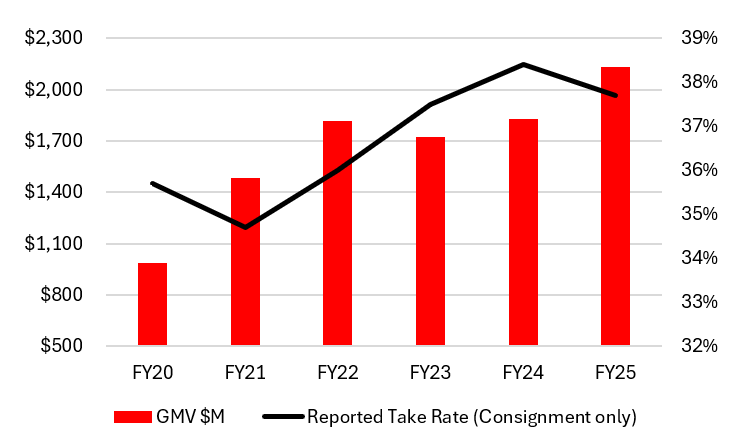
Platform economics are driven by Gross Merchandise Value (GMV), calculated as orders multiplied by average order value, and the take rate earned on completed consignment sales. GMV has more than doubled since FY20 to $2.13B in FY25, while the reported consignment take rate has ranged between 35% and 38%, reaching 37.7% in FY25.
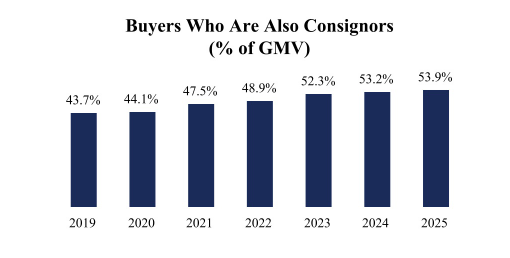
REAL’s customer base is concentrated among affluent Millennial and Gen Z consumers, who represent more than 50% of new consignors and form the largest cohort of “RealRealers,” members who both purchase and consign through the platform. ~40% of new consignors report household income above $150K, while more than 40% of new consignors originate from REAL’s existing buyer base. This overlap strengthens marketplace engagement because buyers can monetize prior purchases and use the proceeds to fund additional transactions.
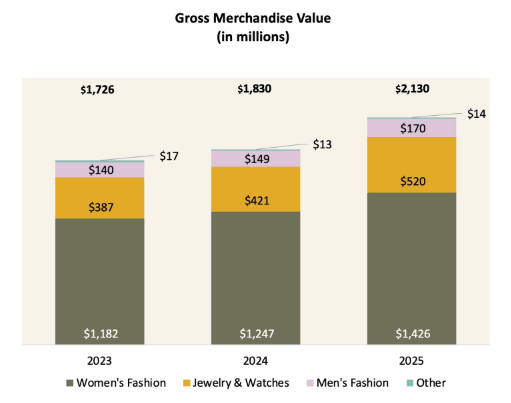
Women’s fashion represented $1.43B, or 67% of FY25 GMV. Jewelry and watches contributed $520M, or 24%, followed by men’s fashion at $170M, or 8%, and home, art, and other categories at $14M. The mix provides exposure to both soft luxury categories such as apparel and handbags and hard luxury categories such as watches and jewelry.
REAL participates in an addressable market anchored by ~$200B of luxury goods held in U.S. closets. This supply is replenished by ~$80B of annual U.S. primary luxury sales, with consumers typically holding items for 3-5 years before recirculating them. ~50% of REAL’s new sellers are also new to luxury resale, indicating that significant supply has yet to enter the secondary market.
The global secondhand apparel market is projected to increase from $257B in 2025 to $393B by 2030. The U.S. resale market is expected to grow from $29.7B to $48.3B over the same period, representing a CAGR of ~10%. Gen Z and Millennials are expected to generate 71% of global secondhand-market growth through 2030.
TAM growth is driven by structural changes in how consumers purchase, own, and monetize fashion. Younger consumers increasingly view secondhand luxury as a regular purchasing channel and are aging into their peak earning and consigning years. Resale value is also influencing primary-market purchases, as consumers evaluate luxury goods based on their potential future recovery value. Demand is further supported by affordability, sustainability, and access to vintage, archival, and discontinued products unavailable through traditional retail. Improved authentication, digital pricing tools, physical drop-off locations, and full-service marketplace models are reducing trust and convenience barriers and bringing additional buyers, consignors, and previously inaccessible closet supply into the market.
Luxury resale is competitive, with platforms differentiated by price point, category focus, authentication standards, and level of service. eBay provides broad horizontal reach through a largely peer-to-peer model, while Poshmark emphasizes social discovery and mass-market fashion. ThredUp operates a managed and highly automated model concentrated in lower-value apparel. Curated platforms such as 1stDibs focus on narrower categories including furniture, fine art, and collectibles. REAL occupies the premium end of the market across both soft and hard luxury categories.
REAL’s competitive position is supported by scale, brand trust, liquidity, and its proprietary data set. The platform’s 15 years of transaction data support pricing and demand forecasting. More than 15,000 items enter the platform daily, creating broad and constantly refreshed selection. Greater supply attracts more buyers, while deeper buyer liquidity improves sell-through and attracts additional consignors.
These network effects are reflected in marketplace retention. More than 80% of GMV comes from repeat buyers, more than 80% of quarterly supply is generated by repeat consignors, and more than 50% of GMV comes from RealRealers who both buy and sell through the platform.
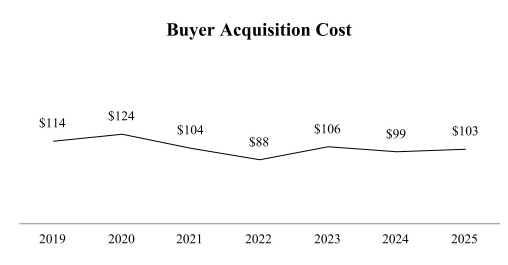
Buyer acquisition cost also declined from $114 in 2019 to $103 in 2025 despite the platform’s larger scale, indicating that marketplace awareness and repeat engagement are reducing the cost of incremental growth.
REAL’s 37.7% reported FY25 take rate is best evaluated against the full range of services included in the model. The company performs authentication, photography, copywriting, pricing, merchandising, insurance, customer service, fulfillment, and returns in-house. Peer-to-peer sellers typically perform these functions themselves or incur separate fees. REAL also absorbs the operational burden created by a 24% to 26% return and cancellation rate. Returned goods stay within its centralized network and can be relisted without requiring additional work or logistics from the consignor. Measured against gross consignment GMV (P14 FY25 estimate: ~$2B), FY25 consignment revenue represented ~26.5%, providing a more comparable view of REAL’s effective revenue yield.
REAL has materially strengthened its balance sheet, generating positive FCF in both FY24 and FY25 while reducing total debt by more than $80M over the same period. As of 1Q26, the company held $123.9M of cash and equivalents, down from $151.2M at FY25 year-end. The company historically relied on convertible debt, including major issuances in 2020 and 2021, to fund growth and preserve liquidity during the pandemic. Balance sheet risk has since declined through debt exchanges completed in 2024 and 2025, which extended maturities and reduced principal outstanding. In FY25, REAL recorded a $40.8M gain on extinguishment after exchanging higher-principal 2028 Notes for lower-principal 2031 Notes. Net leverage has improved to ~5.0x on an LTM basis.
REAL is led by CEO Rati Sahi Levesque, a 15-year company veteran who was appointed to the role in October 2024, and CFO Ajay Gopal, who joined in March 2024. Levesque played a central role in shifting the business toward higher-value supply, stronger unit economics, and sustained profitability. Executive compensation follows a pay-for-performance structure. On a normalized basis, including the annualized value of Levesque’s multi-year equity awards, ~89% of target compensation is at risk. Prior PSU awards included stock-price hurdles of $5.00, $7.50, and $10.00 per share, while current performance awards are tied primarily to cumulative unlevered FCF over multi-year performance periods.
The Top-line Thesis
At ~2.3x EV/TTM Sales, REAL trades at a persistent discount to larger marketplace peers. The valuation implies that Mr. Market views recent growth as part of a finite turnaround and expects the top line to decelerate as comparisons normalize.
P14 expects REAL to sustain revenue growth above the ~10% CAGR projected for the U.S. resale market. Continued execution would support upward estimate revisions and narrow the valuation discount as the market gives greater credit to the duration of REAL’s growth runway.
Product Mix Shift and AOV Expansion
REAL’s shift toward hard luxury allows GMV and revenue to grow faster than order volume. Watches and jewelry carry materially higher selling prices than apparel, increasing the value processed per transaction. The global pre-owned luxury watch market is estimated at $35.7B in 2026 and projected to grow at a 13.3% CAGR through 2033. REAL can capture this opportunity by converting existing fashion and fine-jewelry customers into watch buyers with limited incremental CAC. First-time watch buyers increased 46% in 2025, while 1Q26 AOV rose 15% Y/Y to $646.
REAL’s sourcing network also provides access to original-owner watch inventory that traditional dealers may struggle to reach. In-home appointments and physical stores allow consignors to monetize entire luxury collections in one transaction, including apparel, handbags, jewelry, and watches. REAL’s managed, end-to-end service reduces condition risk, expanding the potential buyer base for transactions ranging from $5,000 to more than $25,000.

Hard luxury also increases GMV throughput without requiring proportional growth in order volume or physical capacity. Illustratively, a $15,000 watch requires a similar storage and fulfillment footprint as a $300 apparel item while generating ~50x more GMV. Watches and jewelry also retain value better than seasonal apparel and can be purchased, worn, and later re-consigned, allowing REAL to monetize the same asset across multiple transactions. The mix shift supports sustained AOV expansion and raises the revenue capacity of REAL’s existing marketplace and logistics network.
Scaled B2B and International Drop-Ship Networks
REAL’s Business Sellers and drop-ship programs expand its supply base beyond individual closets into brands, retailers, boutiques, and professional resellers. These partners can list samples, broken size runs, past-season merchandise, dealer inventory, and other stock that is difficult to liquidate through primary channels. REAL protects the seller’s identity and reports that ~94% of Business Seller items sell within 90 days, providing a discreet channel for converting commercial inventory into cash without severe markdowns. This institutional supply opportunity sits within a global secondhand luxury market that reached ~€50B in 2025 and is incremental to REAL’s consumer closet sourcing.

Drop-ship is a scalable way to grow this business. Select vendors retain custody until an item sells and ship directly to the buyer, allowing each relationship to add commercial-scale supply without routing every item through REAL’s authentication centers. REAL manages risk through partner diligence, provenance requirements, quality checks, and audits. The model expands assortment and GMV capacity without requiring proportional growth in warehouse space or domestic intake volume.
REAL is extending this network internationally through partners in Italy, France, and Japan. European partnerships provide access to boutique and professional reseller inventory, while Japan offers a deep pool of vintage and pre-owned luxury goods. Japan alone holds more than $20B of vintage and archival luxury inventory.
Because REAL does not handle drop-ship inventory, take rates are lower at ~25% vs. ~37% for traditional consignment. B2B drop-ship GMV increased 120% Y/Y to $16M in 1Q26, demonstrating the scalability of the channel. While take rates are lower, near-zero variable intake and storage costs result in a significantly higher contribution margin.
AI’s Impact on the Top Line
Most of REAL’s near-term AI benefit will appear in margins, but the revenue opportunity is also meaningful. Every product is a unique, single-unit SKU, making top-line growth dependent on how quickly new supply reaches the marketplace and how efficiently buyers find relevant inventory.
REAL began rolling out Athena in 2025. Athena is its proprietary AI-enabled intake system, which uses item images and historical data to populate product attributes and descriptions, suggest pricing, assign counterfeit-risk scores, and route lower-risk items through automated processing while directing complex goods to specialists. Athena processed 27% of units in 3Q25 and 35% by FY25 year-end, with management targeting ~50% by the end of 2026. REAL expects Athena to reduce average receipt-to-listing time from 14 days to 7, increasing the volume of supply that can be listed and converted into GMV through the existing authentication-center footprint.
AI also improves price realization and buyer conversion. REAL’s AI-driven pricing engine set launch prices for 85% of items by the end of 2024, while recently added image embeddings allow its models to account for visual characteristics when selecting comparable transactions. This reduces underpricing that sacrifices GMV and overpricing that slows sell-through. On the demand side, REAL is rolling out personalized recommendations and visual, conversational, and agentic search through 2026. These tools are particularly valuable for one-of-one inventory, where buyers may search by image, era, style, color, or other attributes that traditional keyword search handles poorly.
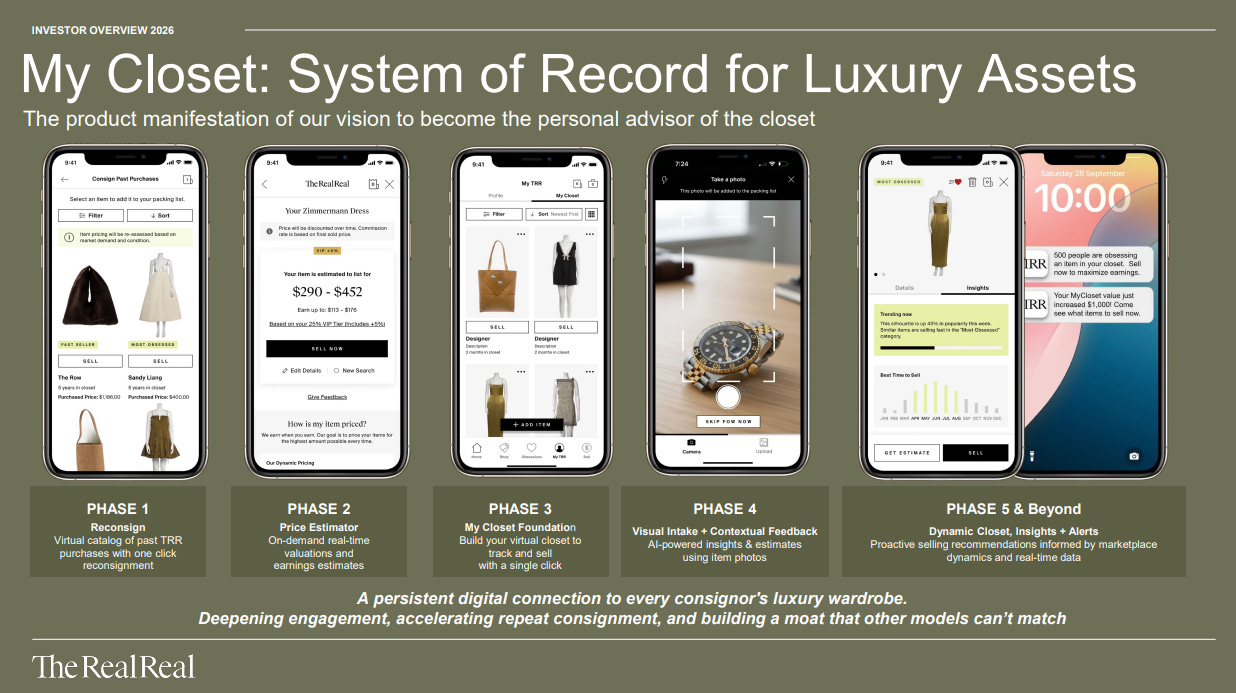
AI is also increasing the productivity of REAL’s supply organization and creating more opportunities to recirculate existing purchases. Smart Sales, launched in 3Q24, uses customer, transaction, and market data to rank consignor leads and identify which clients are most likely to sell high-value inventory. Value generated per sales representative increased 15% in 2024, and REAL added real-time valuation estimates for its sales team in 4Q25. Reconsign launched in 2Q25 as the first component of My Closet, creating a digital catalog of prior purchases and enabling one-click relisting. The broader suite being developed through 2026 adds real-time valuations, earnings estimates, photo-based intake, price tracking, and proactive selling alerts. Smart Sales increases supply acquired per representative, while My Closet turns prior buyers and purchases into recurring sources of GMV.
Direct Revenue and Incremental Monetization
Consignment is REAL’s primary revenue engine, while direct purchases provide an additional top-line lever. Through Get Paid Now, REAL evaluates, authenticates, and prices select watches, handbags, and fine jewelry, then purchases the item before resale. Sellers receive direct-deposit payment within 48 hours or immediate site credit with a 5% premium.
REAL also earns incremental revenue through buyer subscriptions and platform fees. First Look costs $12 per month and provides 24-hour early access to more than 10,000 daily listings and exclusive promotions, while the $49.95 Platinum tier adds upgraded shipping benefits. Subscription revenue was still immaterial in 1Q26, though it offers modest upside as the buyer base grows. Shipping services provide a larger monetization opportunity and benefit directly from higher order volume.
Revenue Build
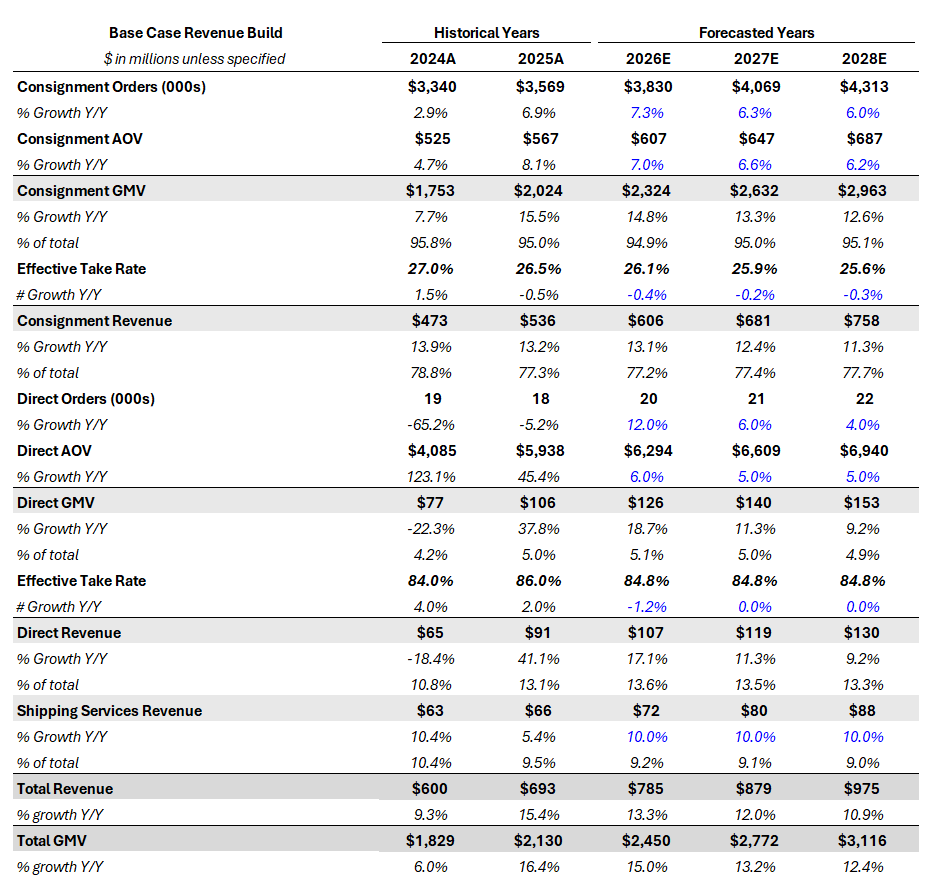
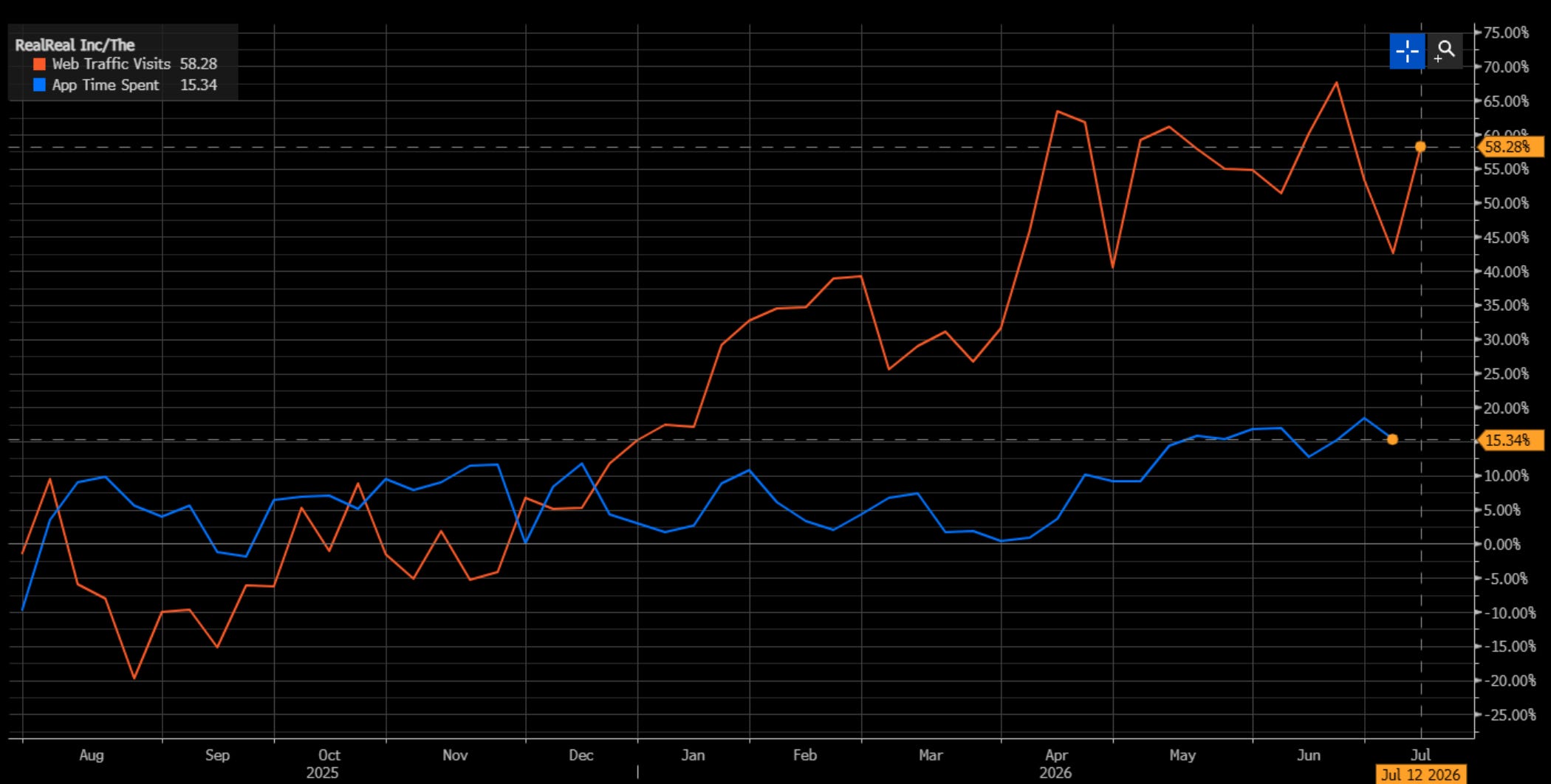
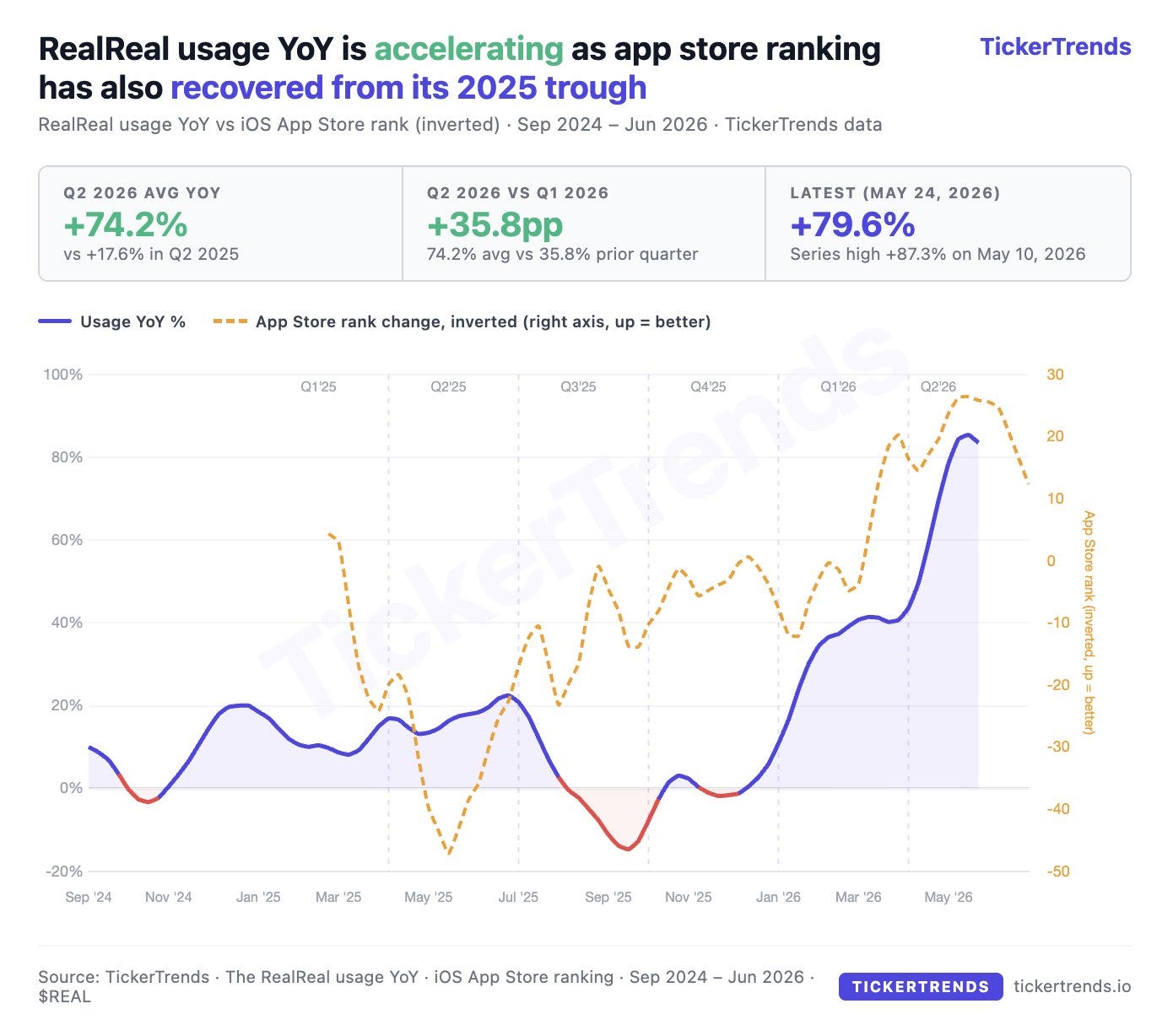
I forecast FY26 revenue of $785M, up 13.3% Y/Y and modestly above the high end of management’s guidance, on GMV of $2.45B, up 15.0% and in line with guidance. Web traffic and app engagement through 2Q26 point to another strong quarter and management’s flat Q/Q outlook leaves room for another beat and raise.
Consignment drives the build, supported by greater supply of higher-value goods, faster speed-to-site through Athena, and continued buyer and order growth as luxury resale adoption increases. I forecast a decline in the effective consignment revenue yield but expect it to remain significantly above peers due to REAL’s luxury focus and unmatched end-to-end service. Direct revenue provides additional support, but its lower-margin profile will keep it as a secondary growth lever. Over the forecast period, I project a 12.1% total revenue CAGR and a 13.5% GMV CAGR, above consensus estimates of 10.8% and 12.8%, respectively, and ahead of management’s HSD-to-LDD medium-term growth framework.
The Margin Thesis
While top-line growth will keep REAL as an attractive candidate in GARP portfolios, the real juice of the investment thesis comes from the margin expansion opportunity inherent in its platform business model. LTM AEBITDA margin is 7.1%, compared with management’s medium-term target of 15%-20%, leaving substantial room for operating leverage as revenue scales across REAL’s existing infrastructure.
Athena as a Margin Multiplier
REAL carries a heavier physical cost base than most platform businesses. The company operates 4 processing facilities across Arizona and New Jersey totaling ~1M square feet, with $21.5M of facility lease expense in FY25. Its retail network also carries fixed occupancy costs, which totaled $38.7M. These facilities are necessary to support intake, authentication, merchandising, and fulfillment, but create meaningful leverage as throughput increases.
Personnel expense represents the largest variable-cost opportunity. Total people costs reached $308.9M in FY25, up 9% Y/Y and equal to ~45% of revenue. REAL incurs an estimated $78 of operations and technology expense per order, including ~$53 of variable labor tied to authentication, photography, and listing.
Athena reduces labor intensity across intake and authentication. AI-enabled tools have cut processing time for certain high-value items from ~30 minutes to 5–6 minutes and eligible inventory is processed ~20% faster and at a lower cost than under manual workflows. This allows transaction volume to scale faster than personnel expense and is the primary source of operating leverage in the model.
AOV and Unit Economics
The shift toward watches, jewelry, and other higher-priced categories improves profit dollars despite lower percentage take rates. REAL has simplified its accepted categories and stopped taking items expected to sell below $100, removing inventory with weak fulfillment economics.
Processing cost does not increase proportionally with item value. A $5,000 watch can require less labor than a $200 apparel item, particularly when it arrives with supporting documentation, while generating materially more GMV and revenue per unit handled. Higher AOV therefore improves labor productivity, warehouse utilization, and contribution profit per order.
Direct revenue is the main mix risk. Direct AOV is ~10x consignment AOV, but its 21.3% gross margin (1Q26) is materially below the 89.4% consignment gross margin because REAL takes inventory ownership. Management continues to treat direct purchases as a selective sourcing tool, with consignment serving as the core volume and profit engine. A few quarters of faster direct growth can pressure reported gross margin, but do not change the longer-term operating leverage available within the consignment model.
High-Margin Revenue Streams
Retail media, advertising, warranties, and return insurance provide additional margin upside with limited incremental operating expense. These businesses are currently immaterial to total revenue, but leverage REAL’s existing traffic and transaction base and can generate attractive contribution margins as adoption increases.
EBITDA Build
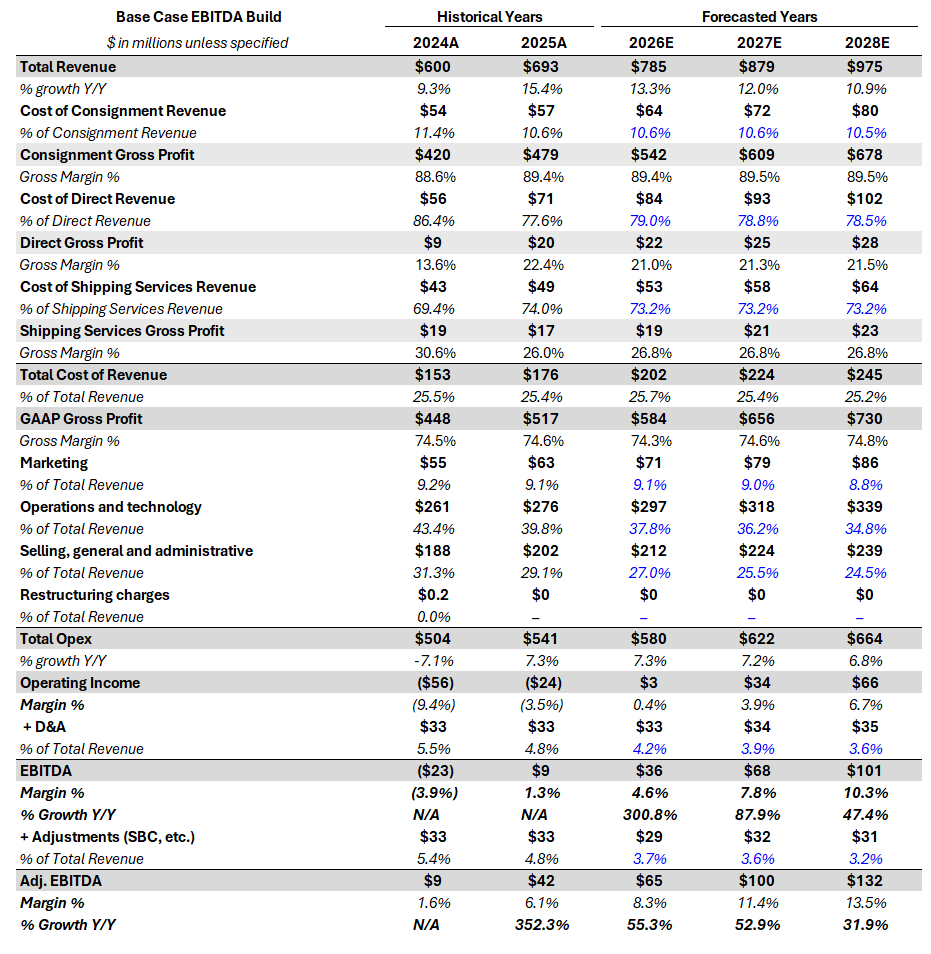
I project gross margin to expand by ~23 bps over the forecast period, driven by modest improvement in consignment gross margin, partially offset by lower direct gross margin.
The larger inflection comes from operating leverage across operations and technology and SG&A, supported by Athena-driven productivity gains. Rather than assuming absolute cost reductions, I conservatively model both expense lines growing more slowly than revenue and declining as a percentage of sales. This drives a GAAP profitability inflection with operating margin expanding by 1,018 bps from -3.5% in FY25 to 6.7% in FY28.
After accounting for D&A and adjustments, primarily SBC, I forecast AEBITDA margin to expand by ~745 bps from 6.1% in FY25 to 13.5% in FY28. My estimates are 8.3% in FY26, compared with the 8.0% midpoint of guidance and 8.3% consensus, 11.4% in FY27 vs. 10.5% consensus, and 13.5% in FY28 vs. 13.3% consensus. The FY28 estimate is still below management’s medium-term target of 15%-20%, leaving additional upside in a bull-case scenario.
Valuation and Base Case
REAL trades at ~2.3x EV/TTM Sales, in line with ThredUp but below Etsy at 3.2x and eBay at 4.5x. ThredUp is the closest resale peer, though its ~$25 AOV and focus on lower-priced apparel limit its exposure to the hard-luxury and AOV tailwinds supporting REAL. No listed peer fully captures REAL’s combination of luxury positioning, consignment economics, network effects, and margin expansion potential.
My base case applies a 3.0x multiple to FY27E revenue, matching REAL’s NTM Sales multiple at FY25 year-end and below the current multiples of Etsy and eBay. This compares with REAL’s current multiple of ~1.9x EV/FY27E Sales. A 3.0x multiple is justified if revenue grows 13.3% in FY26 versus 12.6% consensus and ~12% in FY27 versus 10.4% consensus, while continued execution places AEBITDA margin on a credible path toward management’s 15%-20% medium-term target.
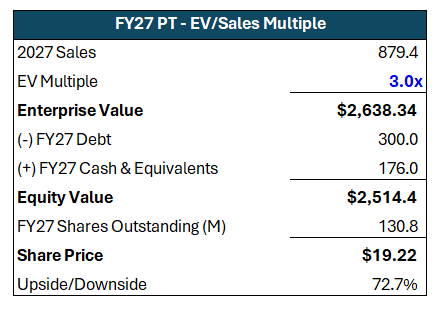
Applying 3.0x to FY27E revenue of ~$879M produces an enterprise value of ~$2.64B. After incorporating a 12% increase in diluted shares from FY25, ~$85M of cumulative debt repayment through FY27, and FY27 cash of ~$176M, I derive a base-case price target of $19.22, representing 73% upside. The expected FCF inflection, combined with management incentives tied to unlevered FCF, provides adequate capacity to address the ~$147M debt maturity in 2029.
Risks and Bear case
Macro sensitivity. Inflation, weaker consumer confidence, or a prolonged economic downturn could pressure discretionary spending and reduce luxury resale demand. Lower buyer activity would weigh on orders, GMV, and revenue, although tighter consumer budgets could also increase consignor supply.
Competition. REAL competes with peer-to-peer marketplaces, managed resale platforms, and traditional luxury retailers. Platforms such as eBay charge lower fees, while larger competitors could invest more aggressively in authentication and resale. Few competitors match REAL’s end-to-end service, but maintaining this differentiation requires continued spending on technology, specialists, logistics, and customer service.
Authentication and reputation. Failure to identify counterfeit or misrepresented goods could damage REAL’s reputation and weaken buyer and consignor trust. Negative publicity related to authentication, shipping delays, returns, or service quality could reduce engagement and increase customer acquisition costs.
Operational infrastructure. REAL depends on a limited number of large authentication and fulfillment facilities, creating concentration risk from fires, natural disasters, labor disruptions, or other interruptions. Cyberattacks, technology outages, and communication failures could also disrupt intake, listings, transactions, and fulfillment.
Supply and labor. GMV growth depends on attracting new consignors, retaining existing sellers, and maintaining a consistent flow of high-quality inventory. REAL also relies on specialized personnel, including gemologists and horologists. Automation should reduce labor intensity across lower-risk inventory, but skilled specialists will continue to be required for high-value and complex items.
In a bear case, revenue growth slows to the mid-single digits as supply, buyer demand, or execution weakens. Applying a 1.5x multiple to FY27E Sales results in a ~$7 share price, representing 37% downside from current levels.
Conclusion
I view the risk/reward as attractive for a long position in REAL. The company is the market leader in authenticated luxury resale, with a longer top-line runway supported by category mix, new supply channels, and continued resale adoption. AI-enabled productivity, higher AOV, and operating leverage support continued AEBITDA margin expansion and stronger FCF, while debt reduction and maturity extensions have improved the balance sheet. With aligned management and the stock trading below larger marketplace peers, successful execution provides a credible path to substantial upside.